Open a score and it feels like a recording on paper: the music, fixed. It is not. A chant manuscript from the 920s shows where a tune rises and falls but not by how much. A Renaissance lute book shows where the fingers go and says nothing about which pitches will come out. A violinist playing Handel with a period-instrument ensemble tunes the A about a semitone below the A of a modern symphony orchestra, and both are playing "the notes".
So every performance of old music is a decision about the unwritten part. Where does the evidence for that part come from? How reliable is it? And who decided what the page would be and what it would leave out? Those are the questions of this course. Each card below plays sound if you tap Play (made in your browser, no files) and also shows the notes and numbers, so it works silently.
- Who takes it
- Year 3 of the Music History specialization of Music. Musicology and early-music degrees teach it as a "sources and notation" course, often with a practical paleography class; ethnomusicology programmes teach the fieldwork and ethics part separately. Specialization guidance comes from musicology and ethnomusicology degrees and the American Musicological Society and Society for Ethnomusicology guidelines.
- What it is for
- Judging a source, reading an old notation, and knowing what a modern edition or performance has added.
- Comes after
- Western Music History: Chant to Now (35/70), which tells the story this course questions.
- Leads to
- It is a method rather than a prerequisite: it prepares you for Music of Latin America & the Caribbean (36/72), where colonial manuscripts and pre-Columbian instruments pose the same questions, and Music, Power & Society (36/73).
- What this piece gives you
- You will not be able to read a St Gall manuscript after this. You will see why a neume cannot be turned into one tune, why a breve is sometimes three beats and sometimes two, why "A = 440" is a 20th-century agreement, and why "authentic" is a word musicologists argue over. Easier first reads: How Recording Changed Music (09/10) and Western Music History: Chant to Now (35/70).
Sources and their silences
There are six kinds of evidence for music of the past. Manuscripts and prints give the notes, in some notation. Treatises and letters describe practice: how to ornament, how to tune, what a good singer does. Pictures (iconography) show who played what and where; surviving instruments show what they could do. Recordings exist only from the late 19th century: the earliest intelligible one is a phonautograph trace of "Au clair de la lune" made on 9 April 1860 by Édouard-Léon Scott de Martinville, which nobody could play back until 2008, and Edison's phonograph followed in 1877. And a living teacher can hand on a practice, though what passes down always changes a little on the way.
No source answers every question. The card shows a judgement, not a measurement, of how well each source speaks to six questions. Switch sources on and off, or jump to the situation of a historian in a given era, and watch what the evidence cannot reach. Before 1877 nothing can answer "how fast?" or "what did it sound like?" better than a treatise, an instrument and a lot of caution.
The scores (0 silent, 1 a hint, 2 good evidence, 3 strong) are a teaching judgement, not data. A recording answers questions about that one performance, and not about how typical it was.
Neumes: writing the shape of a tune
Western chant notation begins in the 9th century. The first marks, neumes, are small signs written above the words: a punctum (a point) for one note, a virga (a rod) for one note carrying stress, a clivis for two notes going down, a podatus (or pes) for two going up. In the earliest "staffless" (adiastematic) manuscripts they show the general shape of a melody, a memory aid for singers who already knew the tune by heart. Heightened or diastematic neumes, placed at different heights to show relative pitch, appear in the early 11th century, and Guido of Arezzo is traditionally credited with the staff of one to four lines that fixed the heights.
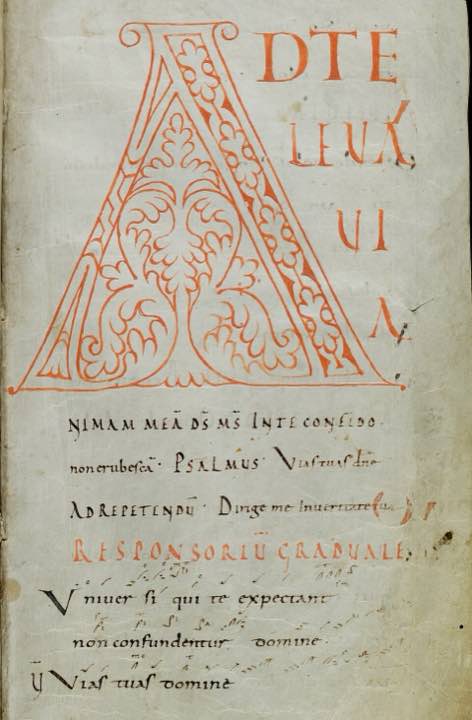

What does a graduate keep from this? A neume page does not contain one tune. It contains a contour, plus whatever the singers carried in memory. Add a line that marks one pitch and you narrow it. Add four lines and a clef and the tune is fixed. The card counts, with live arithmetic, how many different seven-note tunes fit each stage of notation. The tune is the opening of the Dies irae sequence, a 13th-century chant text and melody in the Dorian mode, on its first seven notes: fa-mi-fa-re, mi-do-re (F E F D, E C D).
Stages one and two are schematic: real neumes also carry nuances of rhythm and ornament that this card ignores, and singers knew the repertoire. The counting is exact for the simplified question "which sequences of scale steps are consistent with what the page shows?". The sound is steady, one note per half second; real chant is not sung that way.
Mensural notation: making time visible
Chant has no metre. When singers began to combine several lines, in the Notre-Dame polyphony of about 1200, they needed to know how long each note lasted so the voices would meet. At first this was done by the pattern of notes tied together in groups called ligatures, read according to a few fixed rhythmic modes. A later step, associated with Franco of Cologne's treatise Ars cantus mensurabilis (dated to about 1260 to 1280 depending on the source), gave each note shape its own duration. In the 14th century the Ars nova added the minim and a flexible system of dividing every note into two or three.
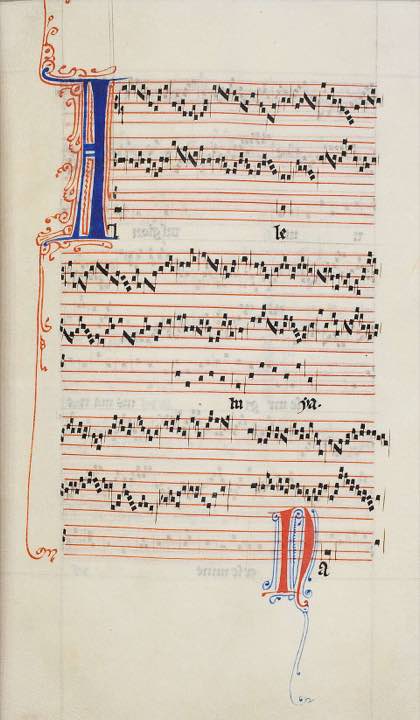

The rule to keep is that a mensuration sign tells you how each note divides. Tempus governs how a breve divides: perfect (a circle) means into three semibreves, imperfect (a half circle) into two. Prolatio governs how a semibreve divides: major (a dot in the sign) means three minims, minor two. Two choices, four combinations, and each is a different metre when you transcribe it to modern barlines.
Drawn in the white notation of the 15th and 16th centuries: breve (hollow square), semibreve (hollow diamond), minim (diamond with a stem). The line is B S S M M S S B (breve, semibreve ×2, minim ×2, semibreve ×2, breve). Imperfection and alteration, which change a note's value by its neighbours, are left out. The reduction to modern metres takes a semibreve as a quarter note (minor prolation) or a dotted quarter (major prolation), a common but not the only choice.
Tablature: writing the fingers, not the sound
Staff notation tells a player which pitch to make. Tablature tells the player where to put the fingers, and the pitch follows from the instrument. Lute tablature came in several national forms: German tablature is traced to the 15th century and the organist Conrad Paumann; French tablature puts lowercase letters on a line for each course (a open, b first fret, c second fret, and so on); Italian tablature uses numbers. In French tablature the top line is the highest course.
Because tablature records fingers, it is mute about pitch. A six-course Renaissance lute was tuned like a tenor viol: fourths between neighbouring courses except a major third between the third and fourth, usually called "in G" from the top course, G C F A D G. Lutes came in many sizes, and there was no pitch standard before the 20th century, so the same tab could sound a tone higher or lower on a different instrument. Set the frets below and the card gives the notes, names the chord if there is one, and lets you change lute size.
Courses run lowest to highest from the left. Open courses on a lute in G sound G2 C3 F3 A3 D4 G4 (G2 is two octaves below G4, and lute music is conventionally written an octave above the sound, as guitar music is). Real lutes double most courses; this card plays one string per course.
Print and the urtext: whose marks are these?
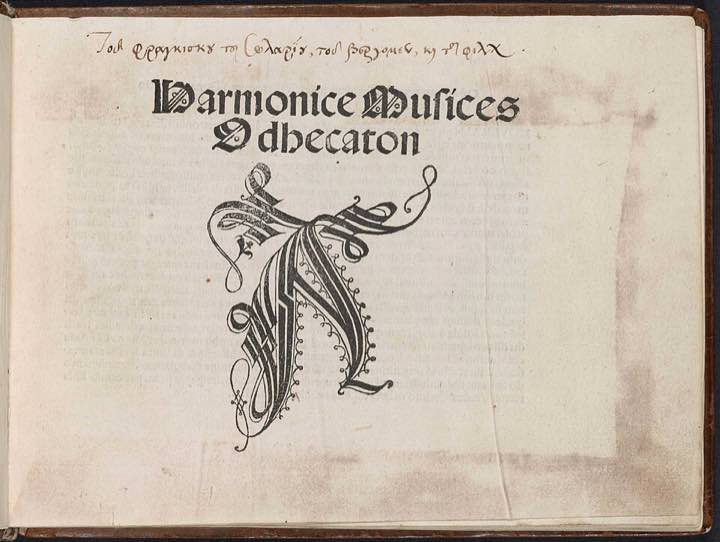
The next change was the printing press. Ottaviano Petrucci of Venice, who petitioned in 1498 for the exclusive right to print music for twenty years, issued Harmonice musices odhecaton A in 1501: 96 chansons, the earliest known printed collection of polyphonic music. He printed each sheet three times, once for the staves, once for the notes and once for the words. About 61 music books followed, most between 1501 and 1509. Print did not create written music, but it made one fixed text that hundreds of people could buy and compare.

A printed or manuscript source is not the same as the version you buy in a shop. Many 19th-century "performing editions" added the editor's own phrasing, dynamics and fingering, and some altered notes and cut passages. Later editors reacted with urtext ("original text") editions that try to print what the composer wrote and nothing else. Even there, an editor must choose between variant sources, correct misprints, and decide what to mark. The musicologist James Webster has argued that many editions called Urtext change more than their editors admit. A good edition lists its sources and shows its own additions in brackets or small print.
An invented eight-note phrase and invented editions, to show the idea. Brackets mark an editor's suggestion; in 16th-century music, singers were expected to raise a note such as F to F♯ in a cadence on G without it being written (musica ficta). Everything outside the first layer is the editor's work.
Pitch: what A meant before 440
An orchestra today tunes to A = 440 Hz, a figure recommended by an international conference in 1939 and adopted as ISO 16 in 1955 and reaffirmed in 1975. Before that, pitch was local and drifted. A tuning fork associated with Handel (1740) gives A = 422.5 Hz. A Paris Opera fork of 1810 gives 423; a Paris fork of 1822 gives 432; one of 1855 gives 449; La Scala before 1859 is reported as high as 451. In 1859 a French law fixed A at 435. Many orchestras today tune a little above 440 (the Berlin Philharmonic is reported at 443). Period-instrument groups today often use A = 415 as a convention for Baroque music: it is almost exactly one semitone below 440.
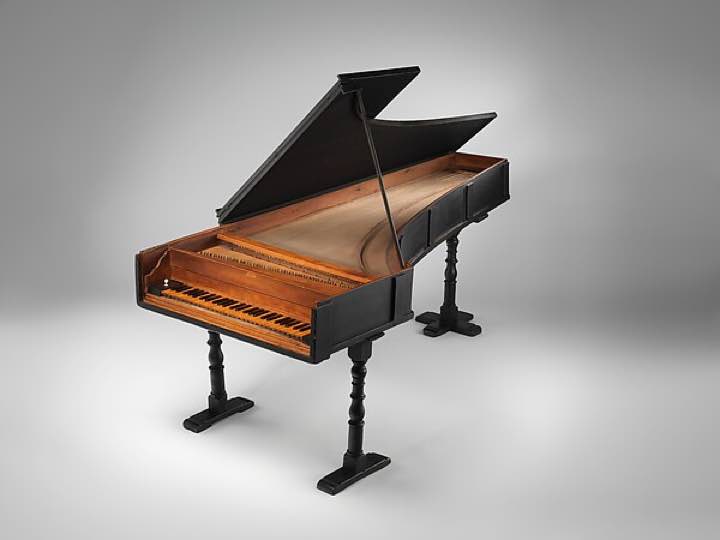
Pitch matters because it changes the music. A singer's high note sits differently; a violin's open strings ring differently; a key may sound brighter or darker. The Verdi tuning of A = 432 has been promoted by some groups, but it sits only about 32 cents under 440, a third of a semitone. The card turns any A into frequencies, a cents offset from 440, and beats against 440.
Equal temperament, A4 as chosen. Frequencies computed in node and checked. Dated values (Handel 1740, Paris 1810, 1822, 1855, France 1859, ISO 16 1955) come from the concert-pitch literature; 415 is the modern Baroque convention.
Historically informed performance and its critics
From the mid-20th century a movement set out to play old music on the instruments, at the pitch and in the style the sources point to. Arnold Dolmetsch, who published The Interpretation of the Music of the 17th and 18th Centuries in 1915 and helped revive the recorder and the viol, is a founding figure; later ensembles such as Nikolaus Harnoncourt's Concentus Musicus Wien, Christopher Hogwood's Academy of Ancient Music and Frans Brüggen's Orchestra of the Eighteenth Century made period instruments a mainstream sound. It is now usually called historically informed performance, because "authentic" overclaims; John Eliot Gardiner has called that word misleading.
The strongest case for it: the sources describe real alternatives to the habits of a modern conservatory, and trying them changed how Bach, Monteverdi and Mozart sound for everyone. The critique is also serious. Richard Taruskin's Text and Act (1995) argued that supposedly authentic performances embodied "a whole wish list of modern(ist) values" and that we can never know how early music really sounded. Daniel Leech-Wilkinson holds that the gap between evidence and a sounding performance is bridged by musicianship and invention. Robert Philip asks why we assume that what sounds tasteful now sounded tasteful then, and Lydia Goehr frames the argument as fidelity to the conditions of performance versus fidelity to the musical work. These are live positions, not a settled score.
One convention the debate has handled well is notes inégales ("unequal notes"): in 17th- and 18th-century France, notes written as equal were often played unevenly in pairs, long then short. More than 85 French treatises between 1550 and 1810 discuss it, and they agree on a rule of thumb (stepwise notes of a certain length, depending on the metre) but not on how uneven. Mechanical instruments suggest ratios of about 3:2, 2:1 or 3:1; the exact amount was left to taste. Whether it applied outside France, in Bach or Scarlatti, was one of the most heated disputes of 20th-century musicology.
Eight notes written equal (a rising C major scale, C5 to C6) played at 100 beats per minute, so each pair of notes fills one beat of 600 ms. At 1:1 the notes are even, at 2:1 you hear triplet swing, and at 3:1 a dotted rhythm.
Fieldwork and its ethics: who is the music for?
Not all musical evidence is old. Ethnomusicology studies music in living cultures, and it grew out of "comparative musicology" in the late 19th century. The Berlin Phonogramm-Archiv began in September 1900, when the psychologist Carl Stumpf used Edison cylinders to record a Siamese theatre troupe visiting Germany; Erich von Hornbostel was its director from 1905 to 1933. Its cylinders (about 30,000 of them) were inscribed on UNESCO's Memory of the World register in 1999. In the 1950s scholars moved from "comparative musicology" to "ethnomusicology", partly to answer the charge that the older approach imposed Western ideas on other music; Jaap Kunst is credited with coining the term. After the Second World War the field moved towards fieldwork, and Alan Merriam (1964) criticised mere collecting of sound. Mantle Hood urged researchers to learn the music they study, an idea he called bi-musicality.
The ethical questions are specific. Who agreed to the recording, and to which uses? Who is credited by name? Who is paid when it is reused? Does a copy return to the community? One documented case shows how much can go wrong after the tape stops. In 1970 the ethnomusicologist Hugo Zemp recorded a Baegu lullaby from the Solomon Islands, sung by a woman named Afunakwa; UNESCO issued it in 1973 on Solomon Islands: Fateleka and Baegu Music from Malaita. The French project Deep Forest later used it, in 1992, without authorization from the singer, Zemp, the label or the distributor, and the album's sleeve wrongly attributed the samples to African Pygmies. The case is cited in ethnomusicology courses as a lesson in how archives and recordings can travel beyond what anyone agreed.
A teaching device built on the documented sequence above; it does not say who was legally entitled to what, which differs by country and by what was agreed.
What a graduate just sees
- Every score assumes a reader who knows the unwritten rest.
- No source answers every question; before 1877 nothing says how fast or how loud, only how someone described it.
- Staffless neumes give a contour, not a tune, and heights, then a staff, narrowed it.
- A mensuration sign decides whether a breve is three or two, and the same line of notes becomes four different metres.
- Tablature records fingers; the pitch depends on the instrument.
- An edition is a layer of someone's decisions, and "Urtext" still hides some.
- "A = 440" is a 20th-century agreement; before it, A varied from about 390 to 450 across places and decades.
- "Authentic" is argued over, and good performers can hold both the evidence and the doubt.
- Recording a living tradition creates duties of consent, credit and return.
Where it shows up next
- Music of Latin America & the Caribbean (36/72) reads colonial cathedral manuscripts and asks what can and cannot be known from pre-Columbian instruments.
- Music, Power & Society (36/73) asks who paid for the sources that survive, and whose music was never written down.
- Acoustics, Tuning & Timbre (35/68) supplies the temperaments and tuning systems that pitch standards sit inside.
- In the world: the musicologist writing programme notes, the editor at a music publisher, the period-instrument player choosing a pitch and a bowing, the archivist deciding whether a recording may be shared.
If you want to go deeper
- 📘 Textbook. Willi Apel, The Notation of Polyphonic Music, 900–1600 (Mediaeval Academy of America, 1942; later editions). The classic guide to reading neumes, mensural and tablature notation.
- 📘 Textbook. Bruno Nettl, The Study of Ethnomusicology: Thirty-One Issues and Concepts (University of Illinois Press; third edition 2015). The standard introduction to fieldwork and its debates.
- 📘 The debate. Richard Taruskin, Text and Act: Essays on Music and Performance (Oxford University Press, 1995), and John Butt, Playing with History (Cambridge University Press, 2002).
- 🌐 Free course. MIT OpenCourseWare 21M.220 Early Music (Fall 2010), with lecture notes and listening.
- 🌐 IMSLP for free scans of manuscripts and old prints, and e-codices for digitised medieval manuscripts, including St Gall.
Music history is read from sources that are partial, written for insiders, and shaped by editors and performers. Learn what each source can and cannot say, read each notation as its own system, and keep both the evidence and the doubt in view.
Try this: this week, listen to the same short piece of old music in two recordings (one on modern instruments, one on period instruments). Write down three differences you hear, then check what the booklet says about pitch and instruments.
Sources. Neumes, adiastematic and diastematic notation, Guido: Wikipedia, "Neume"; St Gallen MS 359 date: e-codices record via Wikimedia Commons. Mensural notation, tempus and prolatio, Franco and the Ars nova: Wikipedia, "Mensural notation". Lute tablature and tuning: Wikipedia, "Lute tablature" and "Lute". Petrucci, the Odhecaton and his output: Wikipedia, "Ottaviano Petrucci". Urtext and performing editions, Webster's critique: Wikipedia, "Urtext edition". Pitch history: Wikipedia, "Concert pitch" (fork dates and values). HIP, Taruskin, Leech-Wilkinson, Philip, Goehr: Wikipedia, "Historically informed performance"; Dolmetsch's 1915 book is cited there. Notes inégales: Wikipedia, "Notes inégales". Ethnomusicology's history: Wikipedia, "Ethnomusicology" and "Berlin Phonogramm-Archiv"; the Baegu lullaby: Wikipedia, "Sweet Lullaby". The 1860 phonautogram: Wikipedia, "Phonautograph". The Dies irae melody begins fa-mi-fa-re in standard sources; its text is attributed to Thomas of Celano or Latino Malabranca Orsini. Every number the cards show (cents, frequencies, beat rates, counts of tunes) was computed in node.
- 🌐 e-codices: Virtual Manuscript Library of Switzerland
- 🌐 IMSLP: the Petrucci Music Library
- 📘 Richard Taruskin, The Oxford History of Western Music (2005), for the story told with its sources.