Clap three beats, three beats, two: ONE-two-three, ONE-two-three, ONE-two. That small pattern, the tresillo, is the skeleton of a Cuban bass line, the three-stroke side of the son clave, the snare pulse of reggaeton, and a rhythm Jelly Roll Morton called the "Spanish tinge". A cell of eight pulses has been carried across more ports than most empires.
This is the subject where that happens at scale. "Latin America and the Caribbean" is not one genre and not one language. It stretches from northern Mexico to Tierra del Fuego and across the islands, with music in Spanish, Portuguese, French, English, Dutch, Haitian Creole, Papiamento, Quechua, Aymara, Guaraní, Nahuatl, Maya languages and many more. The record industry's label "Latin" is a marketing category that gathers a lot of it (the Latin Grammys cover Spanish- and Portuguese-language music made anywhere tied to Ibero-America) and leaves out a lot (reggae and calypso are Caribbean, and they are not "Latin" in that sense). This piece goes by geography and history, and tries to be fair to every country's tradition, not only the four that dominate the textbooks.
- Who takes it
- Year 4 of the Music History specialization of the Music major. Ethnomusicology and Latin American studies programmes also teach "music of Latin America and the Caribbean" as a survey, usually after a general world-music course.
- What it is for
- Hearing how Indigenous, African, European and Asian traditions met in the Americas, and following specific rhythms, instruments and genres from their roots to their present.
- Comes after
- Music Traditions of the World (35/69) and Jazz, Popular Music & the Recording Age (35/71).
- Leads to
- Music, Power & Society (36/73), where states, churches and censors decide what is heard. It also feeds Beatmaking, Sampling & Arrangement (36/69) through dembow and baile funk.
- What this piece gives you
- You will not be able to name every genre of thirty-odd countries; no one can. You will hear the handful of rhythmic cells and string tunings the region keeps reusing, know what survives of pre-Columbian music and what does not, and see how genres travel by port. Easier first reads: Rhythm You Can Feel (09/06) and The Family Tree of Musical Genres (09/03).
Before 1492: the instruments survive, the music does not
The peoples of the Americas made music for thousands of years before Europeans arrived, and none of the great pre-Columbian societies left a notation we can read as pitch. What survives is objects: drums, flutes, ocarinas, whistles, panpipes, trumpets, rattles. There are also pictures (in the Maya painted rooms of Bonampak, in Moche pottery, in post-conquest manuscripts such as the Florentine Codex) and the accounts of Spanish friars, who heard it and wrote about it with their own ears and their own aims.
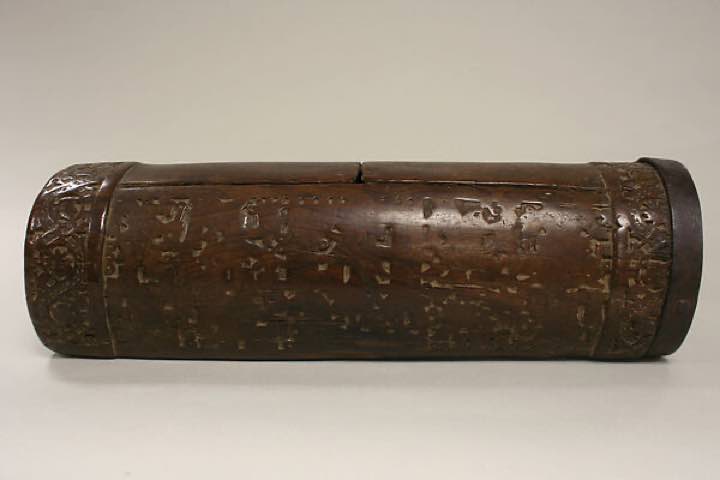
A teponaztli is a hollowed hardwood log with an H-shaped slit that leaves two tongues; because the tongues differ in length or thickness, it gives two pitches, usually a third or fourth apart. Players struck it with mallets, often beside the upright huehuetl. Some Nahuatl poems preserved in the sixteenth century even write out drum syllables (strings such as ti-ki-ti-to), so we know the drum had a voice of two tones, and scholars use those syllables to reconstruct rhythms, though how to turn them into sound is still discussed.
What we cannot know matters just as much. A flute can be measured, and its pitches written down. That does not tell us which notes a player chose, in what order, or what they meant. There is a famous claim that Andean music was "naturally pentatonic", and many Andean tunes do use five-note scales, but surviving instruments show a variety of tunings, and a siku (panpipe) of one community was tuned differently from its neighbour's. Treat any single "scale of the Incas" with suspicion.
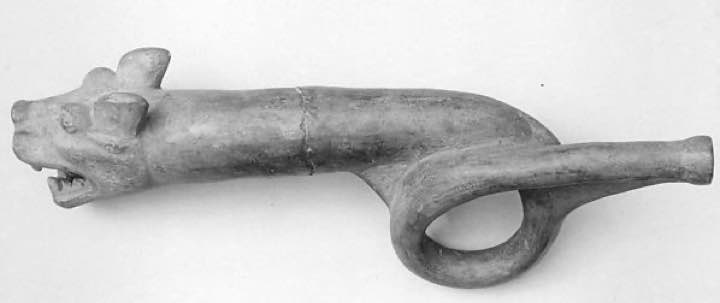
This is not a dead subject. Indigenous musics are living across the region: Aymara and Quechua communities around Lake Titicaca and across the Andes, the Mapuche of Chile and Argentina, the Maya of Mexico and Guatemala, the Guna of Panama, the many peoples of the Amazon, the Wixárika of western Mexico. After 1492 they changed, borrowed, resisted and survived, which is the subject of the rest of this piece.
Physics gives one fact we can test: a panpipe is a set of tubes closed at one end, and a closed tube's pitch is set by its length. Try it.
One bore of 14 mm. Pitch uses f = c / 4(L + 0.3d), where c is the speed of sound in air at your chosen temperature and 0.3d is a small end correction. Sound is optional.
Tube lengths are computed, not measured from any real instrument; real panpipes differ in bore, material and tuning. Both pentatonic sets start on A4 = 440 Hz in equal temperament.
Without JavaScript: a 150 mm tube at 20 °C sounds near 557 Hz, about C♯5; a tube half as long sounds a little under an octave higher, because of the end correction; and warming the air by 10 °C raises the pitch by about 30 cents.
Two things stand out. Halving the tube does not give an exact octave, because the end correction does not halve. And the pitch drifts with the weather: about 30 cents sharper for each 10 °C of warming, almost a third of a semitone. A panpipe in the Andean sun and the same panpipe in morning cold are different instruments. This is part of why "the" tuning of a tradition is a slippery idea.
Cathedral and mission: Europe's music learned, and made, by the people it was imposed on
Conquest brought Christianity, and Christianity brought choirs. Friars in sixteenth-century Mexico and elsewhere ran schools where Indigenous students learned European singing and instrument-making, and Indigenous musicians soon took part in the cathedral choirs and bands. Music was never only a gift or only an imposition: it was both a tool of conversion and the first conservatory the region had.
The cathedral chapels of New Spain and Peru were real musical centres. Juan Gutiérrez de Padilla (about 1590–1664), born in Málaga, spent his last decades as chapel master at Puebla, and over 700 of his pieces survive, mostly motets and villancicos. Gaspar Fernandes (1566–1629), a Portuguese-born composer who worked in Guatemala and Puebla, wrote villancicos in Spanish, in imitations of African speech and in Nahuatl. Juan de Araujo (1646–1712) trained Creole composers at Sucre. Manuel de Sumaya (born in Mexico City in 1680, died 1755) was the most notable composer of New Spain, and the opera La Parténope (1711), with a libretto in Italian, was written for the viceroy; its music is lost. In Lima in 1701, Tomás de Torrejón y Velasco's La púrpura de la rosa was the first opera known to have been composed in the Americas. In Cuba, Esteban Salas (1725–1803) wrote Baroque church music in Santiago de Cuba, which the novelist and musicologist Alejo Carpentier helped rediscover in the 1940s. In Rio de Janeiro, José Maurício Nunes Garcia (1767–1830), the son of mixed-race parents, became chapel master of the royal court.
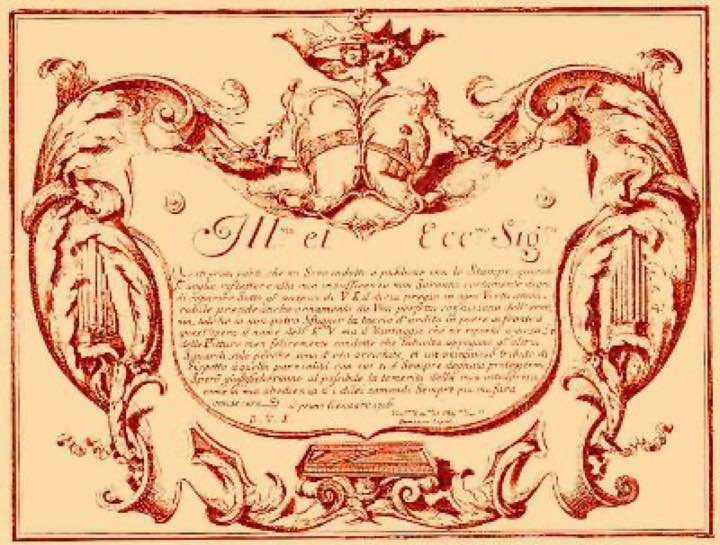

The Jesuit mission towns made a deeper mark. Domenico Zipoli (1688–1726), an Italian organist who held a post at the Gesù in Rome, joined the Jesuits in Seville in 1716, reached Buenos Aires in 1717, worked in Córdoba in what is now Argentina, and died there in 1726, never ordained. In the missions of Chiquitos in eastern Bolivia, founded from 1691, the Swiss Jesuit Martin Schmid (1694–1772) taught music and built churches and organs. After the Jesuits were expelled from Spanish territories in 1767 most mission towns fell into ruin, but the Chiquitos towns survived largely intact, six of them are a UNESCO World Heritage Site (1990), and their music is again played at an international festival held every two years in the mission towns.
Historians disagree about how to read all this. One view stresses the missions' coercion, the loss of Indigenous ritual music and the suppression of languages. Another stresses Indigenous agency: Guaraní, Chiquitano and other musicians were composers, singers and instrument makers in their own right, and much of the surviving manuscript repertoire was copied or made in the missions. Both are true, and the surviving sources rarely give the names of the Indigenous composers.
Africa in the Americas: drums, call and response, and what survived
The Atlantic slave trade moved roughly 12.5 million Africans onto ships between about 1500 and 1867, and about 10.7 million survived the crossing, according to the SlaveVoyages database's 2008 estimates (revised estimates differ in the details). Brazil received more people than any other single region, on the order of four to five million by recent counts, and a large share went to the Caribbean islands. They came from many peoples, among them Yoruba and Fon speakers from what are now Nigeria and Benin, Akan speakers from Ghana, and Kongo and Angolan peoples. Each of these is a different musical culture, not "African music".
What survived, and why, depended on who was allowed to gather. In Cuba, cabildos de nación (associations by African "nation") met for religion and dance. In Brazil, Black brotherhoods took part in church festivals. In Brazil and Cuba the religions of Candomblé (with Yoruba, Fon and Bantu "nations") and Santería (Yoruba-derived, also called Regla de Ocha) kept sacred drumming alive: Cuba's consecrated batá drums, Brazil's atabaques. Haiti's Vodou and its ritual drumming grew out of Fon, Kongo and other roots. Maroon communities, such as San Basilio de Palenque in Colombia, kept their own practices. The Garifuna, descendants of West Africans and Indigenous Caribbean peoples, come from the island of St Vincent and today live along the Caribbean coast of Central America, in Belize, Guatemala, Honduras and Nicaragua; UNESCO proclaimed their language, dance and music a masterpiece of intangible heritage in 2001.
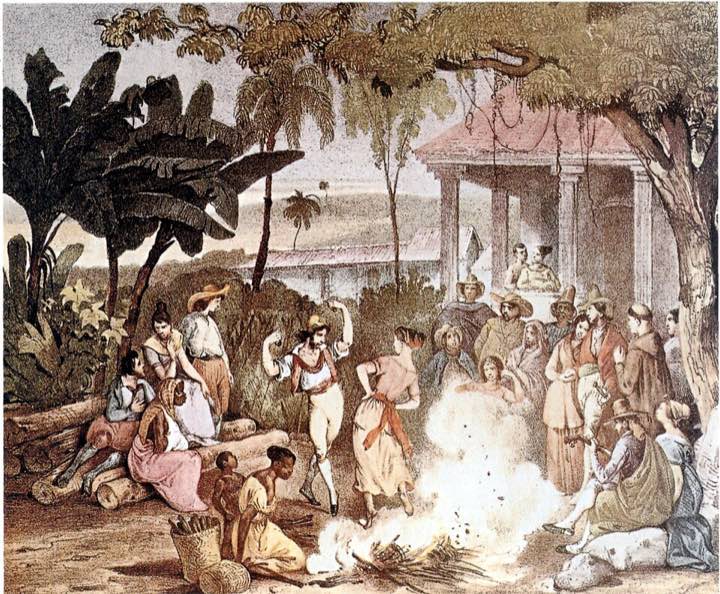

The instruments tell the same story. The berimbau, a musical bow, is of Angolan origin (its name comes from Kimbundu) and plays the lead in capoeira in Brazil. The Peruvian cajón, a wooden box drum, was declared national heritage of Peru in 2001, and was taken into flamenco after Paco de Lucía brought one to Spain in 1977. In Colombia and Ecuador, Afro-descendant communities of the Pacific coast play the marimba, a wooden xylophone, and their tradition is listed by UNESCO; in Guatemala, the marimba is a national symbol, and where it comes from (African xylophones, Indigenous instruments, both) is a question scholars still argue about.
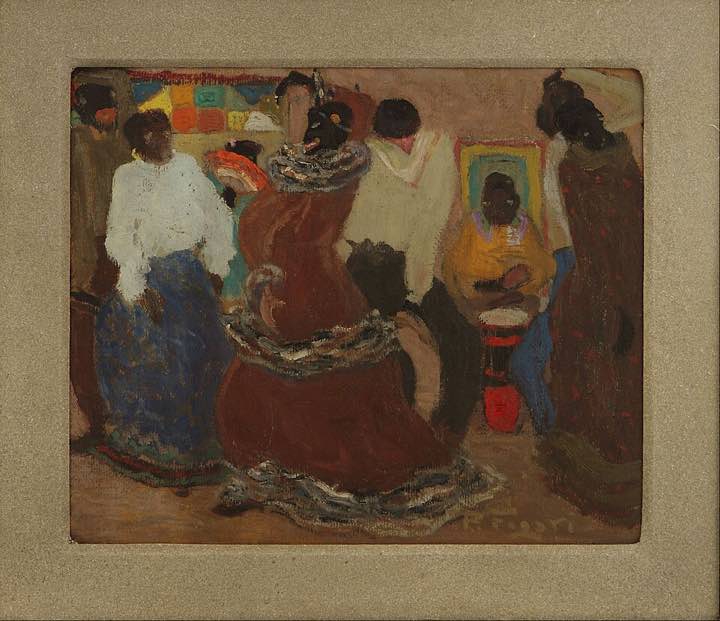

It is a mistake to tell this story as only "three roots". Many Indigenous Americans, Africans and Europeans did meet, but so did others. Indian labourers brought to Trinidad, Guyana and Suriname after emancipation made chutney and other Indo-Caribbean music, and chutney reached a peak of popularity in the 1980s. Chinese workers came to Cuba and Peru, and Japanese to Brazil and Peru. The "three roots" model is a useful first sketch, and every country's real history is more crowded than that.
Three, three, two: the small rhythmic cells everyone borrows
You met the clave in Rhythm, Metre & Groove (35/66). Here is the next step: the same few cells show up in genres that look nothing alike. The tresillo is 3+3+2 over eight pulses. The habanera is the tresillo plus a hit on the third beat. The cinquillo is five strokes with a 2-1-2-1-2 pulse. In Cuban son, the bass tumbao is built on the tresillo, mostly sounding its two off-beats (the first is called the bombo), and it rides on top of the five-stroke clave. Jelly Roll Morton called the tresillo/habanera the "Spanish tinge" and thought it essential to jazz. The tango and the milonga grew in the same world: milonga has been described as a quicker habanera.
The patterns changed hands often. The Cuban contradanza (also called danza or habanera) came from English and French country dances, perhaps brought by French and Haitian refugees from the Haitian Revolution of 1791–1804, and took on tresillo and cinquillo cross-rhythms; the danzón, with Miguel Faílde's Las alturas de Simpson of 1879 (Matanzas) usually named as the first, grew out of it, and went on to the mambo and the cha-cha-chá. Son grew in eastern Cuba in the late nineteenth century, reached Havana around 1909, and was first recorded there in 1917. Salsa, a commercial name for several Caribbean styles, was built mostly on son montuno, and its centre of gravity in the 1970s was New York, with Cuban, Puerto Rican and Dominican musicians. The dembow rhythm that drives reggaeton is the same 3+3+2 grouping, from Jamaican dancehall via Panama and Puerto Rico (see Jazz, Popular Music & the Recording Age, 35/71).
Choose a cell. Press Start to hear it (a wood block for the cell, a low drum on the beats, a bass for the tumbao).
Two-bar claves are counted in eighth notes (16 pulses); the tresillo in eighths (8 pulses); the habanera and cinquillo in sixteenths of a 2/4 bar; dembow in sixteenths of a 4/4 bar, with the kick on every beat and the snare on the fourth and seventh pulse of each half bar. Patterns are standard ones; players vary them.
Without JavaScript: tresillo x..x..x. ; habanera x..xx.x. ; cinquillo x.xx.xx. ; son clave 3-2 x..x..x...x.x... ; rumba clave x..x...x..x.x... ; bossa nova clave x..x..x...x..x.. .
Notice what the grid shows and prose cannot: son clave and rumba clave differ by one pulse, and bossa nova clave, the five strokes under Brazilian guitar, differs from son by one pulse again. Three genres, three countries, one pulse apart.
Six against three: the hemiola of the Hispanic world
A second family of rhythms comes from the Iberian side. In 6/8 you count two groups of three; in 3/4 you count three groups of two; both fill the same six eighth-note pulses. Sesquiáltera (the Latin term for the ratio 3:2, the same thing English writers call a hemiola) is what happens when music switches between them, or plays both at once. A genre in this family leans one way, then the other, and the listener feels a floor that tilts.
The pattern is widespread. The Venezuelan and Colombian joropo alternates 3/4 and 6/8 meters; the Chilean cueca is in 6/8 or 3/4; the Colombian bambuco has a 6/8 or 3/4 dance; the Argentine chacarera accompaniment keeps 6/8 and 3/4 going together; and the Mexican son jarocho belongs to a family of 6/8 genres spread across Hispanic America. This feel is more Iberian in its roots than African, though many of these genres took on Black and Indigenous rhythms and instruments as they went.
Twelve eighth-note pulses are two bars. Genres named are examples of a family, not rules.
Without JavaScript: 6/8 accents pulses 1 and 4 of each bar; 3/4 accents 1, 3 and 5; the alternating pattern plays one bar of each, so accents fall on 1, 4, 7, 9 and 11 over the two bars.
One guitar, many tunings: the plucked strings of the region
Spanish instruments arrived with the conquerors, and the Americas remade them. The guitar's relatives are everywhere: the Venezuelan cuatro (a four-string instrument that descends from the Renaissance guitar and is tuned like a ukulele with two strings an octave lower), the Mexican vihuela of the mariachi and its huge bass the guitarrón (developed from the Spanish bajo de uña), the Cuban tres, the Puerto Rican cuatro, and the Andean charango, traditionally made from an armadillo shell, though modern ones are wooden. The harp, the accordion (the base of vallenato and norteño) and the bandoneón (the German instrument of tango) came by sea too.
The remarkable thing is how many of these use re-entrant tuning, where the string order does not climb from low to high. That makes strumming open strings produce a ready-made chord. Hear for yourself.
Tunings are standard ones (in equal temperament, A4 = 440 Hz); players retune. Notes are written as letter names and fixed-do solfège.
Without JavaScript: the charango's open strings G C E A E spell an A minor seventh; the cuatro's A D F♯ B spell a D sixth; the guitar is E A D G B E.
Ports and circuits: how a genre travels
Almost nothing in this region stays where it was born. Genres move along ports, rail lines and radio. Habanera rhythm ran from Havana to Spain and to Buenos Aires; the Peruvian zamacueca became the Chilean and Bolivian cueca; Cuban son went to New York in the 1930s and to West Africa and the Congo, where it fed Congolese rumba; mambo travelled from Havana to Mexico City and New York; Panama's Afro-Caribbean communities made Spanish-language reggae in the late 1980s, and Puerto Rican producers turned it into reggaeton in the early 1990s. Colombian cumbia, from the Caribbean coast, travelled to Mexico, Peru (where electric guitars made chicha), Argentina and beyond. Brazil built its own circuits: samba from Bahia and Rio, forró from the Northeast, funk carioca from Rio's favelas in the 1980s.
The map below dates when each form is usually said to have taken shape. The dates are approximate and every form has a longer, messier prehistory. Dots mark the main city or region where the form is usually placed; they are not borders.
Schematic: dots sit near one city or region per form, with latitude and longitude drawn on a plain grid. Dates are rounded and contested; a few forms have older roots than shown. The list is not complete.
Without JavaScript: the table below lists a signature tradition or two for each country; read it alongside the dates in this section.
A tour, country by country
One or two traditions each, to show the spread. Every country has many more, and none is a "minor" tradition.
| Country or territory | Traditions to know |
|---|---|
| Mexico | Mariachi (Jalisco), son jarocho (Veracruz), huapango (Huasteca), corrido, norteño, banda |
| Guatemala | Marimba |
| Belize and Honduras | Garifuna punta and paranda |
| El Salvador | Xuc, cumbia, marimba |
| Nicaragua | Palo de mayo, marimba |
| Costa Rica | Calypso of the Caribbean coast, marimba |
| Panama | Tamborito, típico, cumbia, reggae en español |
| Cuba | Son, danzón, rumba, nueva trova |
| Haiti | Kompa (compas), rara, troubadour songs |
| Dominican Republic | Merengue (UNESCO, 2016), bachata (UNESCO) |
| Puerto Rico | Bomba, plena, danza, salsa |
| Jamaica | Mento, ska, reggae (UNESCO, 2018), dancehall |
| Trinidad and Tobago | Calypso, steelpan, soca, chutney |
| Barbados | Spouge, tuk |
| Martinique and Guadeloupe | Biguine, zouk, gwoka drumming |
| Curaçao | Tumba |
| Suriname and Guyana | Kaseko; chutney |
| Colombia | Cumbia, vallenato, bambuco, Pacific marimba and currulao |
| Venezuela | Joropo, gaita zuliana, and El Sistema, the national network of youth orchestras |
| Ecuador | Pasillo, sanjuanito, marimba of Esmeraldas |
| Peru | Huayno, vals criollo, Afro-Peruvian festejo and landó, marinera, the cajón |
| Bolivia | Sikuri (panpipe ensembles), morenada, saya, cueca |
| Chile | Cueca, nueva canción |
| Argentina | Tango, chacarera, zamba, chamamé (UNESCO, 2020) |
| Uruguay | Candombe (UNESCO, 2009), murga, milonga |
| Paraguay | Polka paraguaya, guarania (José Asunción Flores, 1925), the Paraguayan harp |
| Brazil | Samba, choro, bossa nova, forró, frevo (UNESCO, 2012), maracatu |
Songs as public speech: nueva canción, censors and the dance floor
Governments and markets built "national" music out of local forms. Chile declared the cueca its national dance in 1979, a year when the country was under military rule; Venezuela named joropo its national dance and music in 1882; the Dominican dictator Rafael Trujillo (in power 1930–1961) promoted merengue as the national style. Bachata, by contrast, was long looked down on by middle- and upper-class Dominicans as lower-class music, and it is now on UNESCO's list. Who gets to count as "national" is a decision, and the decision changes.
From the 1960s, singers across the region used folk forms as public speech. Nueva canción in Chile grew from the work of Violeta Parra (1917–1967) and was carried by Víctor Jara (1932–1973), Inti-Illimani and Quilapayún; in Argentina Mercedes Sosa and Atahualpa Yupanqui drew on folklore; Cuba's nueva trova (Silvio Rodríguez, Pablo Milanés) put a poet's guitar at the centre of the revolution's culture; Brazil's Tropicália (1967–68) and the MPB tradition, with Caetano Veloso, Gilberto Gil and Chico Buarque, mixed samba with rock and avant-garde ideas under a military government. These movements were not all of one political colour, and neither were their governments: some artists were exiled, some imprisoned, some co-opted.
Víctor Jara's death is the best-documented example of music's risks. He was arrested on 12 September 1973 after the military coup, held with hundreds of others at Estadio Chile, and killed days later, on 16 September, at the age of 40. In June 2016 a Florida jury found a former Chilean army lieutenant liable for his death in a civil suit, and in July 2018 eight retired Chilean officers were sentenced for the murders of Jara and Littré Quiroga. See Music, Power & Society (36/73) for the wider pattern of music and censorship.
Caribbean music was public speech too. Calypso, which began among Afro-Trinidadians in the nineteenth century, carried news, satire and comment, as plena in Puerto Rico did (it was nicknamed the "sung newspaper"); reggae's lyrics range from politics and social commentary to religion and leisure, and its UNESCO listing cites its contribution to discourse on injustice, resistance, love and humanity.
And the dance floor goes on changing. In 2017 "Despacito" topped the US Billboard Hot 100 for 16 weeks, tying the record at the time; in February 2026 Bad Bunny's Debí Tirar Más Fotos became the first entirely Spanish-language album to win the Grammy for Album of the Year, and a week later he headlined the Super Bowl halftime show, drawing both praise and a polarised response. Genres such as reggaeton and corridos tumbados now draw debate too: critics point to lyrics about violence and gender, and defenders reply that these forms continue old traditions of storytelling and that every generation's popular music is told to be a menace. Puerto Rican artist Bad Bunny was Spotify's most-streamed artist of the year four times between 2020 and 2025.
What a graduate just sees
- "Latin" is a market label, not a genre; the region's music is Indigenous, African, European and Asian at once, and every country has its own mix.
- We know pre-Columbian instruments, not pre-Columbian tunes; a measured flute gives a pitch, not a scale.
- The cathedrals and missions taught European music to Indigenous and mixed-race musicians, who then composed it; read the sources for coercion and for agency.
- A few rhythmic cells (tresillo, habanera, cinquillo, clave, dembow) do an enormous amount of work, and a one-pulse shift separates genres.
- Hemiola, the tilt between 6/8 and 3/4, is the Iberian side of the rhythm, as clave is the African side.
- Re-entrant tunings make open strings sound like chords, which is why the cuatro, the charango and the vihuela feel so friendly.
- Genres move by ports and radio, and the same pattern reappears in a country far from where it began.
- Songs are public speech, and the states, markets and censors that decide what is "national" are part of the story.
Where it shows up next
- Music, Power & Society (36/73): nueva canción, censorship under military governments, and the question of who gets to call a music "national".
- Beatmaking, Sampling & Arrangement (36/69): dembow, baile funk and the drum-machine grids that those genres run on.
- Musicology: Sources, Notation & Performance Practice (36/71): how the colonial manuscripts of Puebla, Lima, Sucre and Chiquitos are read and performed today.
- In the world: any dance class (salsa, bachata, tango, cumbia), the playlist of your region, a church choir that sings a colonial villancico at Christmas, and the Latin Grammys.
If you want to go deeper
- 📘 Textbook. Peter Manuel with Kenneth Bilby and Michael Largey, Caribbean Currents: Caribbean Music from Rumba to Reggae (revised edition, Temple University Press, 2006); and Malena Kuss (ed.), Music in Latin America and the Caribbean: An Encyclopedic History (University of Texas Press, four volumes).
- 📘 Gentler. Ned Sublette, Cuba and Its Music: From the First Drums to the Mambo (Chicago Review Press, 2004), a long, readable history; and John Charles Chasteen, National Rhythms, African Roots: The Deep History of Latin American Popular Dance (University of New Mexico Press, 2004).
- 📘 Older survey. Gerard Béhague, Music in Latin America: An Introduction (Prentice-Hall, 1979).
- 🌐 Free to explore. UNESCO's lists of intangible cultural heritage at ich.unesco.org/en/lists, which include dozens of this region's traditions with film and text, and the Smithsonian Folkways recordings catalogue (folkways.si.edu).
The music of Latin America and the Caribbean is five centuries of Indigenous, African, European and Asian traditions meeting, and it is easiest to hear through a few reusable things: rhythmic cells such as tresillo and clave, the tilt of 6/8 against 3/4, open-string tunings that make chords, and the ports and radios that carried them. We know the instruments that came before 1492 but not the tunes, and we know that cathedrals and missions taught and employed Indigenous and mixed-race musicians who made music of their own. Every country has its own signature, and none is a footnote.
Try this: pick a song from this region that you already love, and listen for one thing only: is the groove three-three-two, a 6/8 that tilts to 3/4, or a clave under something else? Then find where that cell came from.
Sources. Teponaztli, drum syllables and cuicatlahtolli, Wikipedia "Teponaztli"; Met Museum records for the images (object 312583, 505009); siku tuning and community variation, Wikipedia "Siku"; composers, dates and missions, Wikipedia entries for Padilla, Fernandes, Araujo, Sumaya, Torrejón y Velasco, Salas, Nunes Garcia, Zipoli, Schmid and "Jesuit Missions of Chiquitos" (UNESCO World Heritage 1990); slave-trade totals, SlaveVoyages estimates (2008) and Wikipedia "Atlantic slave trade"; berimbau, cajón, marimba, candombe, Garifuna, reggae, merengue, bachata, frevo, chamamé, joropo UNESCO notes, the respective Wikipedia entries; tresillo, habanera, cinquillo and tumbao, Wikipedia "Tresillo", "Tumbao", "Contradanza", "Danzón", "Son cubano", "Salsa music"; hemiola and genre meters, Wikipedia "Hemiola", "Joropo", "Cueca", "Bambuco", "Chacarera", "Son jarocho"; Venezuelan cuatro and charango tuning, Wikipedia entries; Víctor Jara, Wikipedia entry; Latin Grammys, Wikipedia; "Despacito" and Bad Bunny, Wikipedia (Grammys of 1 February 2026; Super Bowl LX of 8 February 2026). Pedro Figari dates, Wikipedia. Not every Wikipedia statement was checked against a second source; treat dates as approximate.
- 📘 Manuel, Caribbean Currents
- 📘 Sublette, Cuba and Its Music
- 🌐 UNESCO intangible heritage lists