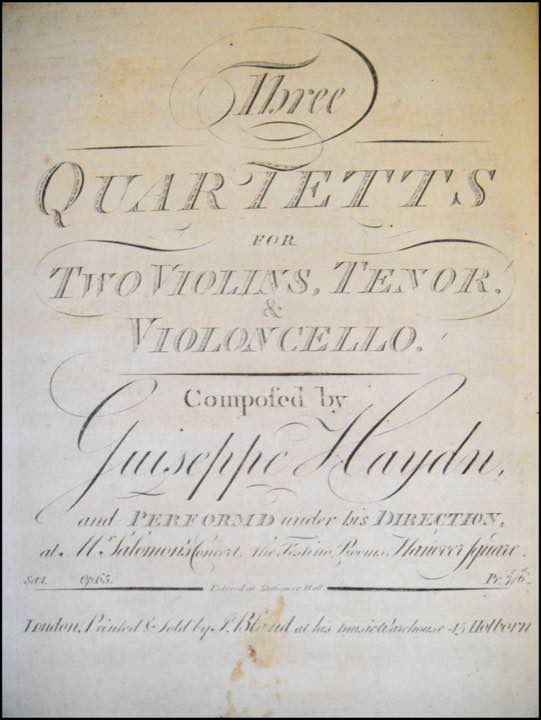
Haydn spent nearly thirty years as the employee of a Hungarian prince. For much of that time the family owned his compositions, so a tune could not travel to a publisher without the prince's say. A few decades later the same composer was selling tickets in London and his quartets were printed with the price on the title page. The notes did not change much. What changed was who was paying, and with it who could hear the music, when, and at what length.
Music feels like the most personal of the arts, and it is. It is also one of the most controlled: it needs rooms, instruments, trained players, printing or recording, and an audience that can reach it. Whoever supplies those things has power over what exists. This course follows that power through churches, courts, states, empires, markets and machines, and asks who was left out each time. Each card works silently with numbers; none needs sound.
- Who takes it
- Year 4 of the Music History specialization of Music, drawn from musicology, ethnomusicology and cultural-studies programmes. Specialization guidance comes from musicology and ethnomusicology degrees and the American Musicological Society and Society for Ethnomusicology guidelines. It is taught as a seminar of case studies, often called "music and politics" or "music and society".
- What it is for
- Asking, of any music, who paid for it, who permitted it, who is missing, and what the medium allowed.
- Comes after
- Western Music History: Chant to Now (35/70) and Jazz, Popular Music & the Recording Age (35/71).
- Leads to
- Nothing: it is the last subject of the specialization. It borrows the evidence habits of Musicology: Sources, Notation & Performance Practice (36/71) and the money mechanics in Producing Records & the Music Business (36/70).
- What this piece gives you
- You will not be able to write a dissertation on one regime after this. You will carry a set of questions, six well-sourced cases, and a feel for how a gate shapes what passes through it. Easier first read: How Recording Changed Music (09/10).
Follow the money: who paid for the music
For most of history a few kinds of patron paid for most of the music that survives. The church trained singers, owned the books and decided what was sung. A court hired musicians as servants, to honour the prince and fill occasions. Francesca Caccini was by 1614 the best-paid musician at the Medici court in Florence, and her La liberazione di Ruggiero (1625), regarded as the first opera by a woman, was written for a visiting Polish prince. Printing and public concerts created a market: Ottaviano Petrucci petitioned in 1498 for a twenty-year exclusive right to print music and published the Odhecaton in 1501 for sale. States, record companies and streaming platforms are later patrons, and each pays for something different.
Haydn's career runs through three of them. In 1761 Prince Paul Anton Esterházy hired him as Vice-Kapellmeister, and he became Kapellmeister in 1766, serving chiefly Prince Nikolaus at the palace of Esterháza. Until a new contract in 1779 the family owned his compositions; afterwards he could write for other patrons and sell to publishers. When Nikolaus died in 1790 his successor dismissed most of the court musicians, and Haydn, travelling with the impresario Johann Peter Salomon, made two trips to London (1791 to 1792 and 1794 to 1795) that produced some of his best-known symphonies.

The pattern to keep: a patron does not only fund the music, it shapes the occasion, the length, the audience and the risk. A cathedral wants music for a service. A prince wants an evening's entertainment. A concert-goer buys a seat and expects novelty. Try sorting nine moments by who made them possible. Some are mixed, and the card says so.
Each item has a best fit, not a sole patron: Haydn's court also supplied publishers after 1779, and Sumaya wrote for a viceroy as well as a cathedral. Order is shuffled each time.
Music for a nation
Nations are also patrons, and sometimes the most effective ones are those without a state. In 1899 the Russian Empire, which ruled Finland, tightened censorship of the Finnish press. Jean Sibelius wrote the music that ends a series of tableaux for the Press Celebrations of that year, and revised it in 1900 as Finlandia: a covert protest, first performed in Helsinki on 2 July 1900. Inside the empire it was played under other titles. Its calm hymn tune is often called a folk melody; Sibelius composed it. Its fame has made it a candidate for a national anthem, and the tune was also used as the anthem of the short-lived state of Biafra.
Nearly a century later singing did the same work in a mass movement. The Singing Revolution in Estonia, Latvia and Lithuania ran from 14 June 1987 to 6 September 1991. Crowds sang at the Tallinn Song Festival Grounds in June 1988; Estonia issued a Sovereignty Declaration in November 1988 and declared independence on the late evening of 20 August 1991. These are two cases of the same idea: a song can say what a speech cannot, and a shared song makes "we" audible. The same mechanism cuts the other way. A national music is chosen, which means someone's music is left out, and states have used songs to rally, to exclude and to control.
Censorship and resistance
Censors can only act on what they can read. Words are the easiest target, then people (who may perform), then instruments, and last of all sound as such. That is why music often slips through, and also why regimes have sometimes banned a whole style or an instrument. The six cases below span a century and four continents; they are described, not ranked, and nothing here says one is worse than another. Pick one and read the record as it is documented.
Dates and figures as given in the standard reference accounts. "Reported" marks claims that rest on press reports. Where court findings exist, they are named.
Two lessons recur. First, the ban often fails to end the music: musicians kept playing in secret and in exile under the Taliban of the 1990s, and mass singing was central to three countries' road to independence. Second, the cost to the performer is real and not symmetrical. The Chilean courts' sentences of 2018, the Florida jury's civil verdict in 2016 and the Supreme Court's confirmation in 2023 came decades after the death of Víctor Jara, which shows how long the accounts take to settle. Music does not stay safe because it is beautiful.
Empire, plantation and the question of credit
Colonial power worked through music in two directions: banning what colonised and enslaved people played, and taking what they made. After the Stono Rebellion in South Carolina began on 9 September 1739, the colony passed the Negro Act of 1740, which among many other restrictions, according to a quotation of its wording, barred "using or keeping drums, horns, or other loud instruments" which might be used to give signals; historians note it is unclear how far this was enforced. In Trinidad the colonial authorities banned percussion instruments in the 1880s, and musicians' workarounds helped lead to the steelpan. The ban did not end the music; it redirected it.
The other direction is credit. In 1939 Solomon Linda and the Evening Birds recorded "Mbube" at the Gallo studio in South Africa. Linda sold his rights to Eric Gallo for ten shillings, and a court later judged the deal unfair, noting he could not read and did not understand royalties. The Weavers recorded a version as "Wimoweh" in 1951, and in 1961 the Tokens' "The Lion Sleeps Tonight" reached number one in the United States. In 2004 Linda's descendants sued Disney over the song's use in The Lion King; the case settled, and in 2006 the rights-holder Abilene Music agreed to pay the family royalties from 1987 and a share of future income until 2017. Rian Malan's 2000 Rolling Stone essay had brought the story to wide notice. The Baegu lullaby sampled by Deep Forest (see Musicology, 36/71) is a related case.
Both stories are about who controls the means: the law, the studio, the contract. Neither is about talent. They also show why scholars ask whose music is in the archive and on what terms.
Who got to compose?
The history of composers is also a history of who was allowed in the room. Women composed throughout, often under constraints. Caccini's opera of 1625 is one landmark. Fanny Mendelssohn Hensel wrote hundreds of works, most unpublished in her lifetime (see Western Music History, 35/70). Ethel Smyth (1858 to 1944), the English composer, wrote "The March of the Women" in 1911, which became the anthem of the suffragette organisation WSPU; she served two months in Holloway Prison after joining the stone-throwing of 1912, and Thomas Beecham found the prisoners singing in the quadrangle while she leaned from a window, conducting with a toothbrush. In 1922 she became the first female composer made a Dame.
Gates were also in the orchestra. The Vienna Philharmonic, founded in 1842, did not admit women to permanent membership until 1997, when the harpist Anna Lelkes was accepted at a meeting on 28 February; by Dec 2019 it had 15 women among its members, and in 2012 women were about 6% of members, against 14% in Berlin, 30% in London and 36% in New York.
One often-told remedy is the blind audition, where a screen hides the player. In 2000 the economists Claudia Goldin and Cecilia Rouse reported in the American Economic Review that screens raised the chance of a woman advancing from preliminary rounds and could account for part of the rise in women among new hires. Others, including the writer Jonatan Pallesen, argue the paper's data are too thin to carry its headline figures; defenders note that orchestras adopted screens for their own reasons and that a noisy dataset is not proof of no effect. The question is open and a good case study in reading a statistic. The simulation below is not that data: it is an invented model that shows how bias in scoring can change who is hired.
Illustrative model: 200 applicants (100 women, 100 men) with equal ability distributions; the panel hires the top 10 by score. The open audition adds the bias to men's scores. Averages over 300 runs; random seed changes each time you press Run, so figures move by a point or two.
The medium decides what fits
Technology is a gate too. A 10-inch 78 rpm record could hold about three and a half minutes a side and a 12-inch disc four to five, a limit commonly credited with fixing the length of popular songs near three minutes. The 12-inch LP, launched by Columbia on 21 June 1948 at the Waldorf Astoria, offered about 23 minutes a side. In the 1980s the compact disc settled on 74 minutes: the popular story is that Sony's Norio Ohga wanted all of Beethoven's Ninth Symphony to fit on a disc, but the Philips engineer Kees Immink calls this a myth and notes the 120 mm size was adopted in December 1979, before the final coding was settled.
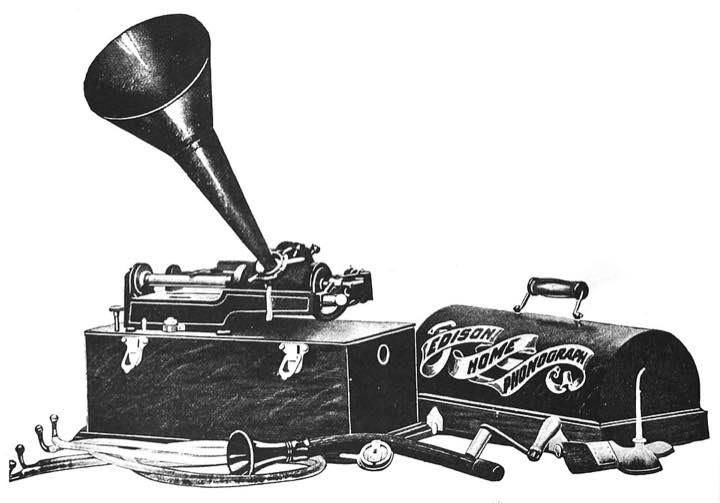

Streaming has a different shape: no side to fill, but thresholds. Industry sources report that a play usually counts as a stream after 30 seconds, and in 2024 Spotify began to require at least 1,000 plays in the previous 12 months before a track earns recorded-music royalties, a rule for the recording side only (not publishing). Each of these gates favours certain music: short songs, albums with a running time, tracks that grab a listener in half a minute. The card runs your piece of music, of any length, through each medium.
Typical playing times: 3.5 minutes a side for a 10-inch 78, 4.5 for a 12-inch 78, 23 for a 12-inch LP side, 74 for a CD. Real discs varied, and long works were often cut to fit. Finlandia usually runs 7.5 to 9 minutes; Beethoven's Ninth is commonly about 65 minutes.
What a graduate just sees
- Every piece of music passed through gates, and each gate chose some music over other music.
- A patron shapes the occasion, the length and the audience, not just the funding.
- A national music is selected, and a shared song can make a people audible.
- Censors act on what they can read: words first, then people, then instruments, rarely sound itself.
- Bans often fail to end the music and still cost the performers.
- Credit and money follow control of the studio and contract, not talent.
- Who composes and who plays has been regulated, and bias in scoring is measurable.
- The medium defines the length: 3.5 minutes a side, 23 minutes an LP side, 74 minutes a CD, a 30-second stream.
Where it shows up next
- Producing Records & the Music Business (36/70) turns these gates into royalties, splits and contracts.
- Music of Latin America & the Caribbean (36/72) is a worked example: colonial cathedrals, African drumming and what it became.
- Musicology (36/71) supplies the source-criticism habit: who made this record, for whom?
- In the world: the curator planning a programme, the policy-maker writing a streaming rule, the festival booking a banned artist, the teacher choosing whose music to teach.
If you want to go deeper
- 📘 Textbook. Christopher Small, Musicking: The Meanings of Performing and Listening (Wesleyan University Press, 1998). Treats music as something people do together.
- 📘 Textbook. Susan McClary, Feminine Endings: Music, Gender, and Sexuality (University of Minnesota Press, 1991). A founding text of feminist musicology.
- 📘 Gentler. Alex Ross, The Rest Is Noise: Listening to the Twentieth Century (2007), with chapters on music under Stalin and Hitler.
- 📘 Jacques Attali, Noise: The Political Economy of Music (1977; English translation, University of Minnesota Press, 1985).
- 🌐 Free course. MIT OpenCourseWare 21M.380 Music and Technology: Contemporary History and Aesthetics (Fall 2009).
Music reaches us through gates: patrons, nations, censors, empires, the people allowed to compose, and the media that decide what fits. Asking who stood at each gate explains why the music we have sounds as it does, and why some of it is missing.
Try this: pick one song you listened to this week and write down the gates it passed through: who paid for it, who could have stopped it, what medium you heard it on, and how that medium shaped its length.
Sources. Haydn's employment and London trips: Wikipedia, "Joseph Haydn". Caccini: Wikipedia, "Francesca Caccini". Sumaya: Wikipedia, "Manuel de Sumaya". Petrucci: Wikipedia, "Ottaviano Petrucci". Finlandia: Wikipedia, "Finlandia". Singing Revolution: Wikipedia, "Singing Revolution". Shostakovich and Lady Macbeth: Wikipedia, "Lady Macbeth of the Mtsensk District (opera)". Degenerate music: Wikipedia, "Degenerate music". Makeba: Wikipedia, "Miriam Makeba". Fela Kuti: Wikipedia, "Fela Kuti". Víctor Jara: Wikipedia, "Víctor Jara". Afghanistan: Wikipedia, "Music of Afghanistan". Stono and the Negro Act: South Carolina Encyclopedia, "Slave Codes", and Bunk History's quotation of the act. Trinidad: Wikipedia, "Canboulay". Solomon Linda: Wikipedia, "Solomon Linda". Ethel Smyth: Wikipedia, "Ethel Smyth". Vienna Philharmonic: Wikipedia, "Vienna Philharmonic". Goldin and Rouse, American Economic Review 90(4), 2000, with critiques by Jonatan Pallesen and Faye Flam's defence as reported in press commentary. Mamie Smith: Wikipedia, "Mamie Smith". Records and LPs: Wikipedia, "Shellac record", "LP record". CD: Wikipedia, "Compact disc". Spotify's 2024 threshold: Spotify's announcement as reported by trade press. Every number the cards show was computed in node.
- 🌐 MIT OpenCourseWare 21M.380
- 📘 Richard Taruskin, The Oxford History of Western Music (2005), for the court and church contexts.