Clap your hands in an empty kitchen, then in a bedroom with a bed, a carpet and curtains. The kitchen answers with a short, bright ring. The bedroom answers with almost nothing. Neither room has changed your clap; each has only decided how long to keep repeating it, and which parts of it to keep.
Now sing one low note in a small bathroom and slide up slowly. At some pitch the whole room seems to join in, and a little higher it goes quiet again. You have just found the room's own notes. Record a guitar in that bathroom, or listen to a mix in a bedroom with a corner full of boomy bass, and the room is on the recording whether you wanted it or not.
A graduate of this course hears decay time, resonant notes, the first echo off the side wall and the thin wall that lets the neighbours in. Each comes from a short formula, and you can play with each below. (Numbers here are for understanding; a real studio or hall is designed from measured product data and a qualified acoustician.)
- Who takes it
- Year 2 of the Sound Engineering major, as the room-and-space course beside microphones and digital audio. Audio degrees such as Surrey's Tonmeister programme teach it, and architecture schools teach the same material as "architectural acoustics" (for example MIT's 4.431).
- What it is for
- Predicting and shaping what a room does to sound: how long it rings, which notes it favours, which reflections reach the listener, and how much sound leaks in or out.
- Comes after
- Acoustics, Tuning & Timbre (35/68).
- Leads to
- No later subject lists it as a prerequisite, but every listening decision in Mixing & Signal Processing (36/63) and Mastering & Loudness (36/64) depends on a room you can trust, and Live Sound Reinforcement (36/66) is this subject played out in halls, tents and fields.
- What this piece gives you
- You will not be able to design a studio from this page. You will see why a room rings for the time it does, why bass piles up in corners, why thin walls fail, and why concert halls are shaped the way they are. Easier first reads: Waves and Sound in 13 Physics, Acoustics, Tuning & Timbre (35/68) and Music Technology & Production (35/73). This piece goes further.
Reverberation time: how long a room keeps talking
Stop a sound in a room and it does not stop at once. Every reflection loses a little energy each time it hits a surface, so the sound fades away rather than switching off. Reverberation time, written RT60 or T60, is how long the sound takes to fall by 60 decibels, a drop to one millionth of its energy, which is roughly "until you can no longer hear it".
Wallace Sabine, a young physicist at Harvard, found the rule in the 1890s. The university had a new museum lecture hall whose echoes made speakers hard to follow, and he began measuring it in 1895, timing a sound dying away with an organ pipe and a stopwatch and moving cushions in and out to change the absorption. What he found is the formula every acoustician still starts from:
In words: a bigger room holds more sound and rings longer; more absorption makes it ring shorter. A surface that absorbs everything (an open window) has a coefficient of 1; a polished concrete wall absorbs about 2% (0.02). The coefficient depends on frequency, so a room has a different T60 for bass, mids and treble. Sabine's formula works best in rooms that are fairly live. Carl Eyring (Bell Labs, 1930) gave a version, T60 = 0.161 V ÷ (−S ln(1 − ᾱ)), that behaves better in rooms with lots of absorption, where Sabine's tends to over-predict. For a heavily treated studio the two differ noticeably; the calculator shows both.
Here is the worked example. A 5 × 4 × 2.8 m room (56 m³) with every surface painted concrete has about 0.9 sabins at mid frequencies and so rings for roughly 5 seconds, a small cathedral. The same room with a carpet and plasterboard walls rings for about 1.4 s at 500 Hz. Add 25 m² of 100 mm mineral wool panels and it falls to about 0.3 s. Build it yourself:
Coefficients are typical rounded textbook values; real products vary (measured to ISO 354). Air absorption is ignored.
Without JavaScript: a 5 × 4 × 2.8 m room of painted concrete rings about 10 s at 125 Hz and about 5 s at 500 Hz and 2000 Hz. With a carpet and plasterboard it reads roughly 0.4 s, 1.4 s and 0.5 s at 125, 500 and 2000 Hz; adding 25 m² of 100 mm mineral-wool panels gives roughly 0.3 s at each (Sabine).
There is no single right T60: it depends on the room's job. A control room wants a few tenths of a second (listening-room standards such as ITU-R BS.1116 ask for roughly a quarter to half a second depending on volume, flat across frequency); a concert hall wants about two seconds so that notes blend. A dead booth makes a voice sound small, which is why a mixing room is tuned, not simply muffled.
Absorption: soft stuff stops treble, only thickness stops bass
Foam, mineral wool, carpet and curtains are porous absorbers. They do not "eat" sound. Air moving in the tiny passages of the material rubs against the fibres and the sound's energy turns into a trace of heat. The catch is that air only moves a lot where the sound wave's air velocity is large, and in front of a hard wall that is one quarter of a wavelength away from it (at the wall itself the air cannot move). So a porous panel does its best work when it is roughly a quarter wavelength thick, or held that far from the wall.
The numbers are the whole story. At 2000 Hz a quarter wavelength is 4.3 cm, so a thin foam tile works. At 125 Hz it is 69 cm, and at 63 Hz it is 1.36 m. That is why a bedroom studio full of thin foam sounds dull on top yet still booms in the bass. The fix is thick absorbers (a deep "bass trap" packed in a corner, or a panel held well off the wall), or resonant absorbers: tuned panels or membranes that soak up energy at one low frequency by flexing.
Green bars: your thickness reaches a quarter wavelength there. A rule of thumb, not a prediction.
Without JavaScript: quarter wavelengths are 136 cm at 63 Hz, 69 cm at 125 Hz, 34 cm at 250 Hz, 17 cm at 500 Hz, 8.6 cm at 1 kHz, 4.3 cm at 2 kHz and 2.1 cm at 4 kHz. A 10 cm panel is a quarter wave at about 860 Hz.
So treating a room is cheap for treble and expensive for bass. The single "NRC" number on many boxes averages 250 to 2000 Hz and says nothing about the bass, so an engineer reads the coefficient at 125 Hz.
Room modes: the room has notes of its own
Between two parallel walls, a sound wave can bounce back and forth and add up with itself, as long as the wall distance is a whole number of half wavelengths. At that frequency the room resonates. These room modes are standing waves: loud at some positions (antinodes, near the walls) and almost silent at others (nodes). A rule you can keep in your head:
A 5 m wall-to-wall distance has its first mode at 343 ÷ 10 = 34.3 Hz, then 68.6 Hz, 102.9 Hz, and so on. A 4 m width gives 42.9 Hz and 85.8 Hz; a 2.8 m height gives 61.3 Hz and 122.5 Hz. Below a certain frequency the modes are far enough apart to be heard one by one, as boomy or missing notes. Above it they overlap into a smooth blur. That boundary is the Schroeder frequency, about 2000 · √(T60 ÷ V) with V in m³: in a 56 m³ room with T60 = 0.4 s it is about 170 Hz. Below it, placement and room shape matter more than treatment.
Shape matters because equal dimensions stack modes on the same frequencies. A cube has its three first axial modes land on one note, and a corner, where every mode has an antinode, excites all of them at once. Try both below, and move your listening position along the length to see which modes you are hearing at their loudest.
Ideal rigid walls, c = 343 m/s; real rooms shift and damp modes. A phone speaker barely reproduces tones below 100 Hz, so use headphones or read the numbers.
Without JavaScript: a 5 × 4 × 2.8 m room has axial modes at 34.3, 42.9 and 61.3 Hz (length, width, height), with 12 modes of all kinds below 100 Hz. A 4 × 4 × 4 m cube puts three modes on 42.9 Hz at once.
The strength of the n-th length mode at position x follows |cos(nπx ÷ L)|: at the exact middle the first mode vanishes and the second is at its strongest; against a wall everything peaks. That is why a bass trap in a corner works on every mode at once.
Reflections: the mirror trick, comb filters and diffusion
A speaker's sound reaches your ear twice: straight, and a moment later after bouncing off a side wall. The delayed copy is a slightly quieter, slightly late version of the same sound, and when two copies of one sound are added, some frequencies reinforce and others cancel. The result is a comb filter, a ripple of peaks and notches across the spectrum that the ear hears as colour or a hollow tone.
You can find the bounce point with a mirror. Sit where you listen and look for the speaker's reflection in the side wall: the spot where you see it is the first reflection point, and that is the place for an absorber. (Acousticians call it the image-source method: the wall is replaced by a mirror image of the speaker behind it.) The extra distance gives a delay of Δt = (extra path) ÷ 343 m/s. For two equal copies the first notch sits at 1 ÷ (2Δt), and the following notches at three, five and more times that.
Ideal mirror wall; reflected path √(d² + (2w)²); level by inverse distance. Plot runs 100 Hz to 10 kHz.
Without JavaScript: speaker and listener 2 m apart, each 1 m from the side wall: the reflection travels 2.83 m, arrives 2.4 ms late and 3.0 dB quieter, and the first notch lands near 207 Hz, about 10.7 dB deep. Absorbing 80% of it leaves the reflection 10 dB down and the notch only about 3.3 dB deep.
The same arithmetic explains a classic home-studio problem: a speaker 0.5 m from the wall behind it cancels at a quarter wavelength, f = 343 ÷ (4 × 0.5) = 171 Hz. That is why many control rooms mount monitors flush in the front wall.
Absorbing every reflection leaves a room dead, so diffusers scatter instead. Manfred Schroeder published the best-known design in 1979: a row of wells whose depths follow a number-theory sequence. For N = 7 wells the sequence n² mod 7 is 0, 1, 4, 2, 2, 4, 1, and each well's depth is its number times λ₀ ÷ (2N), with λ₀ the wavelength of the lowest frequency to scatter. Designed for 500 Hz that is 0, 49, 196, 98, 98, 196 and 49 mm. Diffusers work from a few hundred hertz upward; for bass the room's shape is the only diffuser.
Isolation is not treatment: keeping sound in or out takes mass
People who foam their bedroom wall to stop the neighbours hearing drums are doing the wrong job. Treatment changes what happens inside a room. Isolation controls how much sound gets through to the next room, and for that the ingredients are mass, airtight sealing and separation. Foam is light and porous; sound passes straight through it.
For a single solid wall, the loss in transmitted sound (transmission loss, TL) follows the mass law:
Double the mass and you gain 6 dB; double the frequency and you gain 6 dB. A single layer of 12.5 mm plasterboard (about 9 kg/m²) has a TL of about 12 dB at 100 Hz, about 32 dB at 1 kHz. Two layers (about 18 kg/m²) add 6 dB. A 150 mm dense-concrete wall of around 360 kg/m² reaches about 44 dB at 100 Hz. The deep bass of a kick drum is the hardest to stop.
Then comes the cruel part. The wall is only as good as its weakest part. If a share g of the wall's area is open (a gap under a door, an unsealed socket box), the combined loss is −10·log₁₀((1−g)·10^(−TL÷10) + g). Slide it up below.
Mass 3 to 600 kg/m² (log scale); gap 0 to 5%. Ignores the coincidence dip and panel resonance; real walls are rated by measured STC or Rw.
Without JavaScript: at 100 Hz a 9 kg/m² wall gives about 12 dB, an 18 kg/m² wall about 18 dB and a 360 kg/m² wall about 44 dB. A 1% gap in the 360 kg/m² wall limits it to about 20 dB; a 0.1% gap, to about 30 dB.
This is why the professional answer is a "room within a room": a heavy shell, an air gap, a second shell on resilient mounts so vibration cannot cross through the structure (a flanking path), airtight seals and heavy doubled doors.
Concert halls: Sabine's science meets shoeboxes and vineyards
Sabine's first big test came when the architects McKim, Mead and White hired the young Harvard physicist as acoustical consultant for a new hall in Boston. Symphony Hall opened on 15 October 1900: a rectangle 38.1 m long, 22.9 m wide and 18.6 m high, with statue niches, a coffered ceiling and ornamented balconies that scatter sound. Its mid-frequency decay with an audience is reported as about 1.9 s; the Musikverein's Golden Hall in Vienna (opened 6 January 1870, architect Theophil Hansen, 1,744 seats) as about 2.0 s. Both are tall, narrow "shoeboxes".
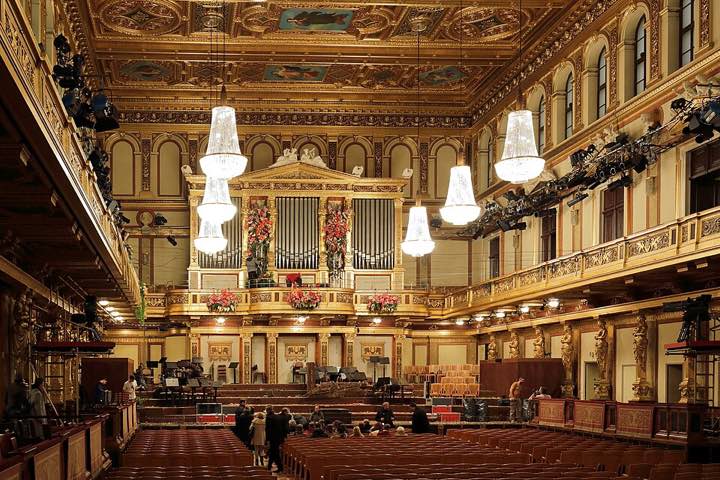

Why do shoeboxes sound so well? A narrow hall sends strong early reflections to each listener from the side, which people hear as being wrapped in the sound; a high ceiling gives the volume for a long decay; and the ornament scatters reflections so they blend into reverberation instead of echoing.
The alternative arrived in 1963. Hans Scharoun's Berlin Philharmonie (opened 15 October 1963, 2,440 seats) puts the orchestra in the middle with the audience on terraces around it, like vineyard slopes, so each block of seats has nearby walls to supply side reflections. Hamburg's Elbphilharmonie (opened 11 January 2017, acoustician Yasuhisa Toyota, about 2,100 seats in the Great Hall) follows the plan and lines the hall with roughly 10,000 individually shaped panels that scatter sound. Both answer the same questions: how to give everyone strong side reflections, and keep them from becoming echoes.
Hall design is older than Sabine. The theatre at Epidaurus in Greece (late 4th century BC) held roughly 13,000 to 14,000 spectators and is still famed for how clearly a voice carries, and Buenos Aires' Teatro Colón (current building opened 25 May 1908, about 2,500 seats) is ranked among the best opera houses in surveys by Leo Beranek. Each one is volume for decay, shape for reflections, surface for scatter.
Putting a control room together, in the right order
A graduate who has to make a bedroom, a garage or a spare office sound honest follows an order, because early decisions cannot be fixed by later ones:
- Choose the room and the layout. Shape and size set the modes: avoid a cube, and keep the listening position off the exact middle and off the back wall. Firing the speakers down the longest dimension is often advised.
- Isolate if you must. It is the most expensive step to fix afterwards.
- Trap the bass. Thick absorbers in the corners, floor-to-ceiling if possible, because corners are where every mode peaks.
- Kill the first reflections. Use the mirror trick for the side walls, and the ceiling, and put a broadband absorber at each point.
- Diffuse the back. A bare back wall can send a late echo; scatter or absorb it, and leave some life in the room.
- Measure and listen. A measurement microphone and free software show the modes and the decay; then check mixes on other systems.
Design schools differ in method but share the aim: studio designers such as Tom Hidley and Don and Carolyn Davis ("live end, dead end") built control rooms with a dead front half and a diffusive back half, and many modern rooms use a "reflection-free zone" around the listener, so the engineer hears the speakers, not the walls. If you cannot change the room, learn it: play tracks you know well and hear what the room does to them.
What a graduate just sees
- A room decays for a time set by its volume divided by its absorption: T60 = 0.161 V ÷ A. Bigger rings longer; softer rings shorter.
- Absorption depends on frequency: thin soft material stops treble, and a quarter wavelength of thickness is needed for bass.
- Every room has notes of its own, f = c·n ÷ 2L, and below the Schroeder frequency you hear them individually.
- Corners are where bass piles up; the middle of the room cancels the lowest mode.
- A single reflection and a direct sound make a comb filter; the first notch sits at 1 ÷ (2Δt).
- Isolation and treatment are different jobs: mass stops sound getting through, absorption controls what happens inside.
- A wall is only as good as its leaks: 1% open area caps any wall at about 20 dB.
- A good concert hall is a decay time, a width, and surfaces that scatter, and there are two ways to get them, the shoebox and the vineyard.
Where it shows up next
- Mixing & Signal Processing (36/63): every EQ move you make by ear is made in a room that is part of the answer; a room with a 63 Hz boom has you cutting bass that is not in the song.
- Mastering & Loudness (36/64): the last decisions on tone and level are the ones most affected by the monitoring room.
- Live Sound Reinforcement (36/66): a PA in a hall or a tent meets the same decay, reflections and echoes, plus a crowd of people who absorb sound.
- In the world: a podcast booth built from a wardrobe, a cinema, an open-plan office, a school canteen, an airport hall whose announcements are unintelligible, a church where speech is slurred and a choir sounds glorious.
If you want to go deeper
- 📘 Textbooks. F. Alton Everest and Ken Pohlmann, Master Handbook of Acoustics (McGraw-Hill), the standard introduction to room acoustics for audio people; Trevor Cox and Peter D'Antonio, Acoustic Absorbers and Diffusers (CRC Press), for the physics and design of the treatments in this piece; and Philip Newell, Recording Studio Design (Focal Press/Routledge), for studios.
- 📘 Gentler. Ethan Winer, The Audio Expert (Focal Press), with a practical, myth-busting section on room treatment; and Leo Beranek, Concert Halls and Opera Houses (Springer), for the stories and data behind the halls.
- 🌐 Free resources. MIT OpenCourseWare's 21M.380 Music and Technology: Recording Techniques and Audio Production (Fall 2016) has a session on room acoustics and reverberation; the building-technology course 4.401 has a lecture on room acoustics.
A room is an instrument you cannot take out of the recording. Its decay follows volume over absorption, its low notes follow wall spacing, its colour follows its reflections, and what leaks out follows mass. Learn the five numbers and you can predict a room before you hear it, and fix the right thing first.
Try this: stand in the middle of a room and clap once, then again beside a wall and in a corner. Then hum a slow rising note in the smallest room in your home and listen for the pitch where the room joins in. You have found a mode, and the first number to check with 343 ÷ (2 × the distance between two walls).
Sources. W. C. Sabine, Collected Papers on Acoustics (1922), on the Fogg lecture room from 1895 and Symphony Hall; C. F. Eyring, "Reverberation time in dead rooms," JASA 1930; M. R. Schroeder, quadratic-residue diffusers, JASA 1979; Everest and Pohlmann, Master Handbook of Acoustics (absorption coefficients, mode and mass-law formulas); Cox and D'Antonio, Acoustic Absorbers and Diffusers; Beranek's hall reverberation measurements (Institute of Acoustics and AES papers); Wikipedia on the halls named, for dates and seat counts; ITU-R BS.1116.
- 📘 Everest and Pohlmann, Master Handbook of Acoustics
- 📘 Cox and D'Antonio, Acoustic Absorbers and Diffusers
- 🌐 MIT OpenCourseWare 21M.380