Put on a track that makes you move and tap the table. Your finger lands on a steady pulse, and between the taps you feel something else: the second hi-hat in each pair arriving a hair late, or a snare that seems to lean back. Now imagine the person who made it. They were probably not performing a drum kit. They were looking at a grid of small squares, switching some on, and dragging one control until the groove felt right.
That grid is the subject of this course. A beatmaker works in three layers. The grid decides where sounds are allowed to happen. The sound source decides what happens there: a drum machine voice, a slice of an old record, a synthesised bass. The arrangement decides how the whole thing unfolds over minutes, which parts arrive, which leave, and when the floor gets what it came for. Underneath all of it is a legal question that shaped a whole art form: who owns the slice?
Everything on this page makes sound in your browser from small bits of code. No recordings are used, so there is nothing to clear. Keep your volume low, press Play to start and Stop to end. Every interactive also shows its numbers, so it works with sound off.
- Who takes it
- Year 3 of the Music Production specialization of Music. Programmes that teach it include electronic production and design degrees such as Berklee's and the production diplomas at schools like Point Blank and SAE. Self-taught producers learn the same material from tutorials and trial and error.
- What it is for
- Building the rhythmic and structural skeleton of a track: programming drums, finding and shaping samples, and arranging sections so that a loop becomes a record.
- Comes after
- Digital Audio & the DAW (36/62) and Rhythm, Metre & Groove (35/66).
- Leads to
- No later subject lists it as a prerequisite. It feeds the finishing subjects of the specialization: Mixing & Signal Processing (36/63), Mastering & Loudness (36/64) and Producing Records & the Music Business (36/70). It sits beside Synthesis & Sound Design (36/68), where the sounds themselves are designed.
- What this piece gives you
- You will not be able to make a finished track after this. You will see where a hi-hat's lateness comes from, why an 808 is a bass note as much as a drum, what happens when you speed up a sample, why a drop works, and what the courts have said about sampling. Easier first reads: Rhythm You Can Feel (09/06), How a Song Gets Made (09/07), How Recording Changed Music (09/10) and Music Technology & Production (35/73).
The grid: sixteen slots and the time between them
Most beat software cuts one bar of 4/4 into sixteen steps, sixteenth notes, and lets you switch a sound on or off in each. You count them "1 e & a, 2 e & a, 3 e & a, 4 e & a". Tempo is beats per minute, so the time between steps is fixed by arithmetic. A beat is 60 000 ms divided by the tempo, and a step is a quarter of a beat.
The first hardware to put this in a musician's hands was the step sequencer of the Roland TR-808, released in 1980. You press numbered buttons for the steps you want, and the machine plays them in a loop.
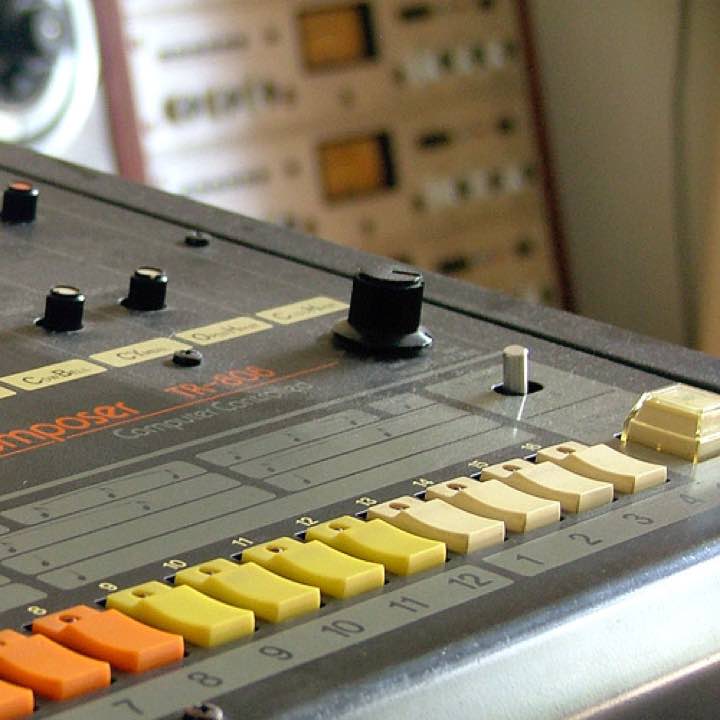

Below is the same idea. Tap squares to build a pattern, or load one of three starting points. The three presets are simplified sketches of well-known patterns, not transcriptions of any record: the house pattern puts the kick on every beat (four on the floor) and a clap on beats 2 and 4; the boom-bap sketch leaves space around a backbeat snare; the dembow sketch (more on it in the genres section) puts the kick on every beat and the snare in a 3+3+2-shaped pattern.
Sounds are synthesised on the spot (a sine kick with a pitch drop, filtered noise for snare and hat). The step highlight shows the nominal grid position; swing and humanise shift when the sound actually plays.
With JavaScript on, this card is a playable sixteen-step drum machine. The idea in one line: at 120 BPM each step is 125 ms.
Swing: the offbeat that arrives late
Straight sixteenths divide each pair of steps in half: the second step of the pair lands exactly 50% of the way through. Swing is the simple, powerful trick of moving it later. Roger Linn's Linn LM-1 (1980) offered a "shuffle" that delayed every other sixteenth, and his later Akai MPC60 (1988) made the setting famous as a percentage: 50% is straight, and larger numbers hand the first step a bigger share of the pair.
Try it in the machine above: load the boom-bap sketch, set the tempo near 90, and slide swing from 50% to 62%. Nothing in the pattern changes, yet the groove goes from stiff to loose. A graduate hears swing as a delay, a few tens of milliseconds, and knows that "feel" is partly a number you can set. Genres choose different amounts and different subdivisions: a lot of house and techno is close to straight, while shuffled and boom-bap styles lean on it. Players call the resulting feel "pocket", and whether it is intention or accident, they are describing the same few milliseconds.
Quantise and humanise: how far from the grid is human?
A drummer playing the same bar twice never lands in exactly the same place. When you play a pad pattern into a sampler, your hits land a few milliseconds early or late of the grid. Quantise pulls each hit toward the nearest grid line; most software lets you pull only part of the way (a strength setting) so some of the feel survives. Humanise goes the other way: it adds small random shifts to a pattern that was clicked in perfectly.
Sixteen hits at 100 BPM (150 ms per step), played "straight" with small invented timing errors. Each bar shows how far a hit is from the grid line it is aiming at.
Timing errors are random, invented numbers for illustration (typical spread about 14 ms), not measurements of a real player. With swing above 50% and strength at 0, the "player" is playing straight against a swung grid, so the offbeats look early.
With JavaScript on, you can slide quantise strength from 0% to 100% and watch the average distance from the grid fall from roughly 12 ms to zero.
Here is the useful judgement. Producers argue about how much to quantise: 100% sounds exact and can sound lifeless; 0% keeps the feel and the mistakes. A common middle path is partial quantise plus accenting by volume. A famous example of working against the grid on purpose is the late hip-hop producer J Dilla, widely described as placing sounds deliberately late or early. The word to hold is deliberate: feel is a choice about the milliseconds, not their absence.
Drum machines: 808 and the sound as a bass note
Early drum machines were circuits, not recordings. The TR-808 (1980 to 1983) made its sounds with analog synthesis: about 12,000 units were made, and it was not a commercial success, selling for US$1,195 at launch. Its bass drum is a sine-like oscillator whose pitch starts high and falls fast, with an amplitude that dies away slowly. Marvin Gaye's "Sexual Healing" (1982) is described as the first US hit to feature the 808. After the 808, Roland's TR-909 (1983) added sampled cymbals and hats to analog drums and became the standard four-on-the-floor kick of house and techno.
Next to it the Linn LM-1 (1980) played back twelve recorded drum samples, 8-bit at 28 kHz. It cost about US$5,000 and only 525 were built; its sound and the MPC60 (released 8 December 1988, with sampling time of up to 13 seconds) are the sampled branch of the family tree. Two branches, one result: both gave a bedroom a rhythm section.
The 808 kick has a quirk the whole of trap and a lot of hip-hop later built on: let its tail ring and tune it and it is a bass note. The pitch sweep gives the "boom", the long sine tail gives the note. That is why a producer tunes the 808 to the key of the song and why it clashes with a bass line that plays another note at the same time.
The waveform is computed from the same pitch curve and decay the sound uses. A phone speaker reproduces little below roughly 100 Hz, so at low notes you mostly hear the drive's overtones, which is one reason real 808 basses are often saturated.
With JavaScript on: at 33 (A1, 55 Hz) and 0.5 s decay, the tail only reaches −60 dB at 500 ms, exactly one beat at 120 BPM.
Sampling and chopping: repitching, stretching and the sixteen pads
A sample is just a short recording stored as numbers and played back on demand. Sampling as a method is older than hip-hop: Pierre Schaeffer's musique concrète cut and looped recorded sound from 1948. In the Bronx of the early 1970s, DJs such as Kool Herc extended the drum "breaks" of funk records by looping them between two turntables. Samplers such as the Fairlight and the Akai MPC later made that a keyboard-and-pad operation.
Two facts about playback matter more than any plug-in. First, the simplest sampler changes pitch and speed together. Play a sample at rate r and it sounds r times as high and takes 1/r as long. A rate of 2 is an octave up in half the time. That "chipmunk" sound of speeded-up soul vocals in some hip-hop is exactly this. Second, if you want to change tempo without changing pitch (time-stretching) or pitch without tempo (pitch-shifting), software has to cut up and recombine the signal, which creates small artefacts when pushed hard.
An invented two-second loop (kick, hats, snare, four plucked notes) made in code. Each of the eight slices is 0.25 s at 120 BPM.
With JavaScript on, you can tap eight pads, reorder the slices and slide the rate. At rate 2 the two-second loop takes one second and sounds an octave higher.
Chopping is the art of slicing a longer sample into pieces, assigning each to a pad, and playing them in a new order. The skill graduates keep is hearing a record as a bin of pieces: a kick, a snare, a chord, a breath. The sixteen-pad layout of an MPC, with its 4×4 rubber pads, was built for exactly this kind of finger drumming.
Arrangement: energy is what you add and take away
A loop is not a track. A listener who hears the same eight bars for four minutes gets bored, and a DJ cannot mix it. Arrangement is the plan for which layers play in which section: a few bars of drums to give a DJ something to mix, a build that adds a layer and a riser, a drop where the bass and lead arrive together, a breakdown where the drums go away and the chords stand alone so the next drop feels bigger. Most dance sections last 8, 16 or 32 bars because phrases of that length feel natural to dancers and mix cleanly with the next track.
The craft insight is that energy is relative. A drop hits because the section before was thinner. Take layers away to make the return feel like arrival. Pop and hip-hop use a different map, with verses, choruses and a bridge, but the same trick: the chorus is louder because the verse left room.
"Energy" here is an illustrative score: layers are weighted (kick 2, hats 1, bass 2, chords 1, lead 2, FX 1) and shown as a share of the maximum. Section lengths are typical, not rules. The preview plays two bars of each section in A minor.
With JavaScript on, you toggle six layers across the sections of a dance track or a song. Example: a 64-bar dance track at 124 BPM lasts about 2 minutes 4 seconds.
One grid, many accents: genres around the world
The same sixteen slots serve very different traditions. Here is a map, with the caveat that each of these is a living scene with disputes over who started what.
| Style | Where and when | The drum idea (as commonly described) |
|---|---|---|
| Boom-bap hip-hop | The Bronx and New York, 1970s onward | Chopped funk and soul breaks; a swung sixteenth grid; kick and snare up front. |
| House | Chicago, early to mid 1980s, from the city's queer Black club culture | Four-on-the-floor kick; off-beat hats and claps; usually 120 to 130 BPM; TR-909 and TR-808 are the machines most often cited. |
| Techno | Detroit, mid 1980s; Model 500's "No UFO's" (1985) is often called the first techno record | Machine-driven drums, 120 to 150 BPM; the Belleville Three (Juan Atkins, Derrick May, Kevin Saunderson). |
| Dembow and reggaeton | Jamaican dancehall riddims of the late 1980s and early 1990s; Panama and Puerto Rico | A 3+3+2 pattern over a kick on every beat. Steely & Clevie's riddim (1989) and Shabba Ranks's "Dem Bow" (about 1990) are the usual reference points. |
| Baile funk (funk carioca) | Rio de Janeiro, from the mid 1980s | Miami bass and 808 loops, especially the "Voltmix", later the tamborzão rhythm; a "150 BPM" style from 2018. |
| Amapiano | South Africa (Gauteng), mid 2010s; origin disputed | Deep house and kwaito roots, piano, and a wide percussive "log drum" bass line; the name comes from the isiZulu word for "pianos". |
| Afrobeats | Nigeria, Ghana and the UK, 2000s to 2010s | An umbrella term for a fusion of sounds, distinct from Fela Kuti's Afrobeat of the 1970s; 4/4 with clave-based cross-rhythms. |
Notice what repeats: a low drum that pulses, a higher drum that answers, and a cross-rhythm laid over the pulse. The 3+3+2 pattern, three steps, three steps and two, is the same shape found in the Afro-Cuban tresillo and the dembow, and in hundreds of rhythms across West Africa and the Americas. Rhythm patterns are not owned, which matters in the next section.
Samples and the law: two copyrights, one slice
Hip-hop's first generation sampled freely. Then the law caught up. A recorded song contains two separate copyrights: the composition (the song as written, owned by its writers and publisher) and the master (the particular recording, usually owned by a label). Taking a slice of a record takes both, so in most cases you need the permission of both owners.
- United States, 1991. In Grand Upright Music v. Warner Bros. Records, a New York federal court enjoined the release of Biz Markie's album I Need a Haircut because it sampled Gilbert O'Sullivan's "Alone Again (Naturally)" without permission. The ruling pushed the industry toward clearing every sample in advance.
- US Sixth Circuit, 2005. Bridgeport Music v. Dimension Films held that copying even a very short piece of a sound recording is infringement: "Get a license or do not sample."
- US Ninth Circuit, 2016. VMG Salsoul v. Ciccone reached the opposite result for sound recordings: a roughly 0.23-second horn hit from "Love Break" in Madonna's "Vogue" was de minimis, too small to matter. The two courts disagree.
- European Union, 2019 and 2026. In the Kraftwerk v. Pelham dispute (a two-second sample from "Metall auf Metall" used in 1997), the EU Court of Justice held in 2019 that using a recognisable sample without permission infringes the producer's rights, while a sample changed so it is unrecognisable to the ear does not. On 14 April 2026 a second ruling (case C-590/23) held that "pastiche" is an EU-wide concept that can cover some sampling when the new work engages in a recognisable dialogue with the original, but not as a general defence. The case returns to the German courts.
There is also a quieter route: replaying the notes yourself (an interpolation) avoids the master but still needs the composition's owner. And chord progressions and common rhythms such as the dembow or a 12-bar blues are not owned.
A simplified map of how the ideas above fit together. It is not legal advice and cannot decide a real case; laws differ by country and change.
With JavaScript on, you pick what you used and where, and the card names the rights holders involved: for a slice of a recording, both the master owner and the composition owner.
This describes how sampling law works and is not legal advice. Laws differ by country and change.
The human cost of the old free-for-all is documented. The "Amen break", a seven-second four-bar drum solo from The Winstons' 1969 B-side "Amen, Brother", was looped in countless hip-hop, jungle and drum-and-bass tracks. Its writer Richard Spencer said he learned of its use in 1996 and never received royalties for it, and drummer Gregory Coleman died in 2006 destitute. A 2015 fundraiser by two British DJs raised more than £18,000 for Spencer, who died in 2020. The story is one of the reasons many producers now treat clearance as part of the craft and not an afterthought.
What a graduate just sees
- A beat is sixteen slots; the time between slots is 15 000 ÷ BPM milliseconds.
- Swing is a delay of the offbeats; the percentage tells you how big a share of the pair the first step gets.
- Quantise is a strength, not a switch, and feel lives in tens of milliseconds.
- An 808 is a drum and a bass note; tune it to the key and mind its tail.
- Speeding up a sample by playback alone raises its pitch by 12·log₂(rate) semitones; stretching without pitch change is a different process.
- Energy is relative: the drop works because the section before it took things away.
- 3+3+2 recurs across Africa, the Americas and the Caribbean.
- A sampled record has two copyrights, and courts do not agree on how short a slice must be to be harmless.
Where it shows up next
- Mixing & Signal Processing (36/63): the kick and the 808 compete for the same low frequencies, and the arrangement you built decides what the mix has to solve.
- Mastering & Loudness (36/64): a dynamic arrangement (quiet verse, loud chorus) is the thing a heavy limiter flattens.
- Producing Records & the Music Business (36/70): the clearance question grows into master and publishing splits and royalties.
- Synthesis & Sound Design (36/68): the 808 kick is an oscillator with an envelope, and the sounds in your grid are designed there.
- In the world: festival sets, game and film temp tracks, streaming playlists where the first seconds decide a skip.
If you want to go deeper
- 📘 Textbooks. Joseph G. Schloss, Making Beats: The Art of Sample-Based Hip-Hop (Wesleyan University Press, 2004), an ethnography of producers and their rules about digging and chopping; and Mark J. Butler, Unlocking the Groove: Rhythm, Meter, and Musical Design in Electronic Dance Music (Indiana University Press, 2006), for how loops and layering create groove.
- 📘 Handbook. Rick Snoman, The Dance Music Manual (Focal Press/Routledge), a hands-on tour of drum programming and arrangement for dance music.
- 🌐 Gentler. Ableton's Learning Music, browser-based lessons where you switch beats, basslines and song structures on and off.
- 🌐 Free course. MIT OpenCourseWare 21M.380 Music and Technology: Algorithmic and Generative Music (Spring 2010), on building music with code.
Beatmaking is three decisions: where sounds sit on a grid (and how late the offbeats lean), what the sounds are (a synthesised voice, a tuned 808 or a slice of something older), and what you add and take away over time. The slice also carries a legal and human history: it contains two copyrights, and the courts of different countries still disagree about how small a taken piece can be.
Try this: pick any song you know and tap the pulse. Then listen only to the hi-hats for one bar. Are the pairs even, or is the second one late? Count the layers at the start of the chorus compared with the verse before it. You are now hearing the grid and the arrangement.
Sources. Roland TR-808 (1980, about 12,000 built, US$1,195; "Sexual Healing" 1982) and TR-909 (1983), Linn LM-1 (1980; twelve 8-bit samples at 28 kHz; 525 built; shuffle swing) and Akai MPC60 (released 8 December 1988; up to 13 seconds of sampling), via the Wikipedia articles on each machine, which cite manufacturer and trade sources; House music, Techno, Reggaeton, Dembow, Baile funk, Amapiano and Afrobeats (Wikipedia articles, as summarised for dates and tempo ranges); Grand Upright Music, Ltd. v. Warner Bros. Records Inc., 780 F. Supp. 182 (S.D.N.Y. 1991); Bridgeport Music, Inc. v. Dimension Films, 410 F.3d 792 (6th Cir. 2005); VMG Salsoul, LLC v. Ciccone, 824 F.3d 871 (9th Cir. 2016); CJEU Case C-476/17 Pelham (2019) and Case C-590/23 Pelham II (Grand Chamber, 14 April 2026), with law-firm summaries and the EU IP Helpdesk note of 24 April 2026; Amen break, Wikipedia, citing BBC News (2015) and The Economist (2011).
- 📘 Schloss, Making Beats
- 📘 Butler, Unlocking the Groove
- 🌐 Ableton, Learning Music